! BOOKS !

Dear Gift Reader,

Hello, may you be healthy and in pursuit of what makes you happy.

I am happy to welcome you to this conversation about reading and making books. Today is a Big Day in my writing and publishing life. Today, December 2, 2025, is the official publication day for The Long Now Conditions Permit!

In this ! Books ! dispatch, I share with you the story of how my second full-length collection has come into being—from writing individual poems to their publication in literary magazines to the selection of the manuscript, The Long Now Conditions Permit, as winner of the 2023 Test Site Poetry Series Prize to finding the perfect cover image.

AnnouncingThe Long Now Conditions Permit!

THE LONG NOW CONDITIONS PERMIT
by Jami Macarty
University of Nevada Press, December 2025

The Long Now Conditions Permit confronts the persistent brutalities of our world through poetry that both names and resists the injustices shaping it. From the quiet sorrows of everyday slight to the overwhelming crises of ecological collapse and gendered violence, these poems document what is occurring—the horrendous and the intimate, the anguished and the magnificent.

With ethical attention, Jami Macarty’s collection engages the political, ecological, and personal forces that shape and mark our lives, offering an ecofeminist ethic of care as an antidote to extractive capitalism and patriarchal norms. Each poem meditates on power, insists on articulating what is being lost—and what must be saved and reclaimed. 

Amid the exploitation and violence, these poems find moments of grace: the scent of a sea rose, a desert walk in spring, the company of birds, Earth entire. The Long Now Conditions Permit is both tender elegy and urgent call, exhorting readers to grapple with the devastating failings of humanity and the saving possibilities of love. 

Winning the 2023 Test Site Poetry Series Prize

On March 4, 2024 my second manuscript of poetry marched forth to its life as a book when I answered a call from Claudia Keelan, editor, who told me The Long Now Conditions Permit won the 2023 Test Site Poetry Series Prize!
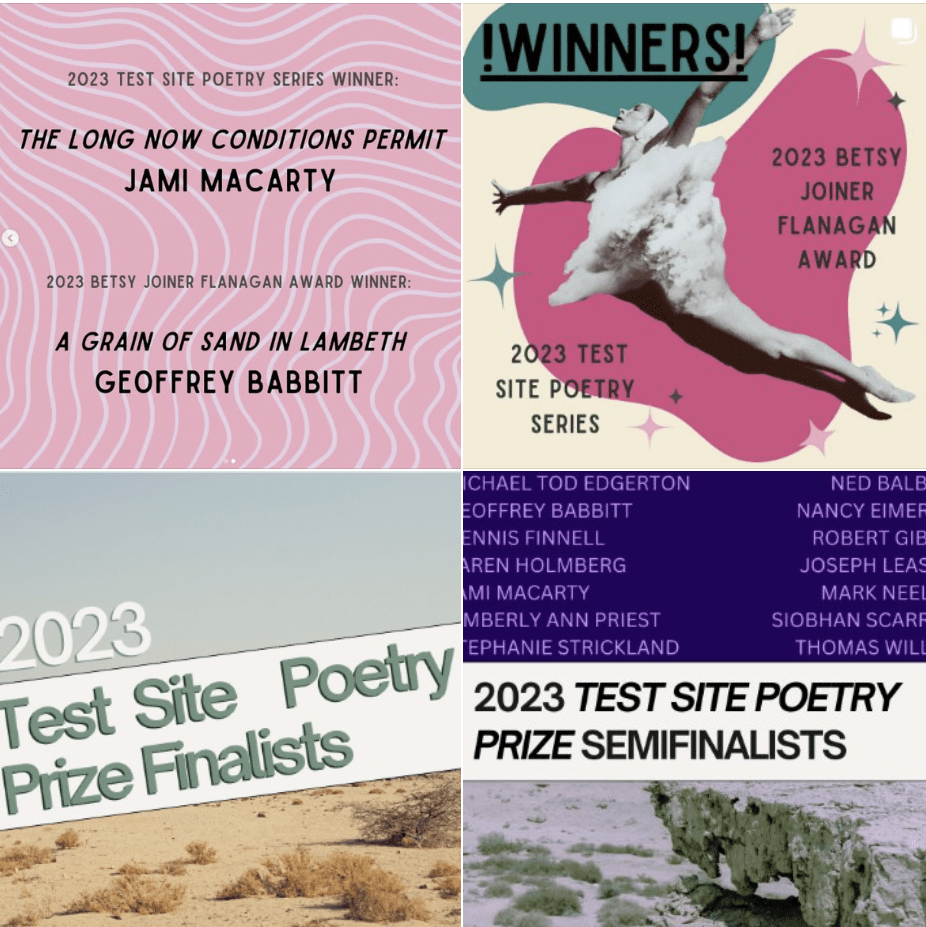
The 2023 Test Site Poetry Prize Semifinalists, Finalists, and Winners!

The Test Site Poetry Series is the collaborative book-publishing project of Interim: A Journal of Poetry and Poetics and the University of Nevada Press. Interim, established in 1944 by the late Wilber Stevens, is housed in the English Department at the University of Nevada, Las Vegas and is one of the longest-running “little” literary magazines in the United States. Interim editors and poets Claudia Keelan and Andrew S. Nicholson serve as Test Site Poetry Series editors. The Test Site Poetry Prize-winning book is chosen by Claudia Keelan and an advisory board, which includes poets Sherwin Bitsui, Donald Revell, Sasha Steensen, and Ronaldo V. Wilson.

The editors and advisory board are looking for manuscripts that engage the perilous conditions of life in the 21st century, as they pertain to issues of social justice and the earth. The winning book will demonstrate an ethos that considers the human condition in inclusive love and sympathy, while offering the same in consideration of the earth. Because we believe the truth is always experimental, we’ll especially appreciate books with innovative approaches.

Now, some of the delicious words The Test Site Poetry Series editorial board members shared about The Long Now Conditions Permit!

from Sasha Steensen (on Facebook):

from Ronaldo V. Wilson (the book’s endorsement):

from Claudia Keelan (the book’s endorsement):

from Donald Revell (the book’s endorsement):

These poets’ words for The Long Now Conditions Permit, heart-expanding gifts!

Finding the Cover Photo

The first time I saw Masahiko Kuroki‘s photograph of the tree (above) was early December 2024, scrolling my Facebook feed. It was late at night after a long day’s driving in a highway-side hotel. I had been stressing over the just-right photo. The publisher didn’t care for my ideas, and I wasn’t wild about theirs. Such is the often fraught book cover conversation!

It’s a mystery as to why Masahiko Kuroki’s photo appeared in my feed. I wasn’t following him. I had never heard of him. Nor had I previously seen any of his photos. Yet somehow rather miraculously his photo appeared. When I saw it, I slid off the edge of the bed. Then recovering myself from the floor, I shined the image toward my partner’s face and asked, What about this for the cover? As if falling off the bed wasn’t enough!

When I shared Mashiko Kuroki’s photograph with the University of Nevada Press team, they said: “But we’re really loving the final image… It’s the most unique of all the images you’ve suggested, or that we’ve found, and I love that the tree can be interpreted literally as a tree, or with just a bit of imagination, as a woman with her arms outstretched.”

As we moved through the design process, their admiration for Kuroki’s photograph grew: “Again, our team just loves this image! It’s so evocative and interesting. I think it’s really going to pull readers in.”

And, as we arrived at the cover’s final design: “For what we’ve started calling the “tree woman” image here in the office, I still think this is the best option, by far. If you want something unique that you’re not going to find on another book cover, this is the image to choose. We were talking about it in our staff meeting this morning, and everyone agrees this is one of the most striking covers we’ve proposed in quite a long time.”

I experience Masahiko Kuroki’s photo viscerally every time I behold it. I feel an upward reaching within me. Masahiko Kuroki’s photo is perfect company for the poems in The Long Now Conditions Permit which feature the figures of trees and women and seek a freedom from the threat of violence that all too often pervades natural and domestic environments.

Thank you to, Masahiko Kuroki, for agreeing to accompanying my poems with his photograph!

Writing the Poems in The Long Now Conditions Permit

I freshly wrote or deeply revised all of the poems in The Long Now Conditions Permit over ninety-five days between January 2020 and January 2021. The poems were drafted/revised among a shifting cohort of other poets during five days in person at a goddess table in January 2020 as the COVID-19 pandemic was just coming to our attention. Then, over three thirty-day online poem-a-day writing sprees in July 2020, October 2020, and January 2021. I loved the practice of trying to write a poem-a-day. The intensity! There were duds, but there were keepers. The process gave me an experience of seeing just what writing I could accomplish in a relatively short period of time. It showed me the momentum of daily practice and power of cumulative effect in writing. The practice offered me a community of writers. And I made some poetry pals!

Generous Publishers of Individual Poems

What makes a full-length collection? Individual poems! They are the building blocks and act as gateways from poem to poem, and engender conversations between poet and editor, poet and publisher. Individual poems have their own lives and are part of the lives of full-length collections. Individual poems are the beginning of a book, and they point to a book when it comes into being.

While searching for my book’s publisher, I tweaked the poems and tried out the revised versions by sending them out for consideration with literary magazines in Canada and the US. This editorial process offered me valuable information about which poems would make up the manuscript of The Long Now Conditions Permit. Sometimes the poems editors believed in were also the poems I believed in. Sometimes not. So, I had to figure out which poems mattered most to the life of the book.

Thirteen editors of literary magazines selected individual poems from The Long Now Conditions Permit for publication in their the literary magazines they helm. I wish to acknowledge the hardworking and devoted editors, staff, publishers, and printers for giving time, attention, and space to my writing. Thank you, Geoffrey Gatza at BlazeVOX; Matthew Cooperman at Colorado Review; Haley Lasché at Concision Poetry Journal; Claudia Keelan at Interim: A Journal of Poetry & Poetics; Simone Muench at The Jet Fuel Review; Robert Julius and Alyssa Froehling at The Journal; Charles Kell at Ocean State Review; Richard Greenfield at Puerto del Sol; Jackie Janusis at Redivider; Jaimie Gusman at Tinfish; Eleni Zisimatos at Vallum Magazine and Vallum Chapbook Series; Gillian Conoley at Volt; Sue Goyette, editor of the anthology Resistance: Righteous Rage in the Age of #Metoo (University of Regina Press, 2020). Special thanks to Interim: A Journal of Poetry and Poetics, Vallum Magazine, and Vallum Chapbook Series for their ongoing support of my writing by publishing my poems in several issues between 2020 and 2024.

I take the time and space above to name these editors and publications as a gesture of gratitude because they took the time with and offered space to my writing. They are important to my writing life. And they are part of the valuable conversation I want to have about my poems and poetry in general.

Seeking a Publisher

In December 2021, I offered for consideration to The Test Site Poetry Series the first version of the manuscript. It was one hundred and twenty pages long! That’s long by most standards. Typically, the recommended length for manuscripts is around seventy pages. The manuscript’s title was, and has always been, The Long Now Conditions Permit. It was named a finalist for The Test Site Poetry Series. Spur! The next year and the one after that, the manuscript was on the shortlist with Canada’s Brick Books. Spur! Spur! Then, in March 2024 it won the 2023 Test Site Poetry Series Prize! In all, I offered the manuscript for consideration forty-one times.

For me, the story of how The Long Now Conditions Permit came into being sums to two words: Persistence! Perseverance!

Now, Seeking Readers

Now, for my book I seek readers! Gentle, generous readers who will give The Long Now Conditions Permit the gift of their attention. I would love to count you as one of my poetry collection’s readers! Will you be one of The Long Now Conditions Permit‘s readers?

: : : :
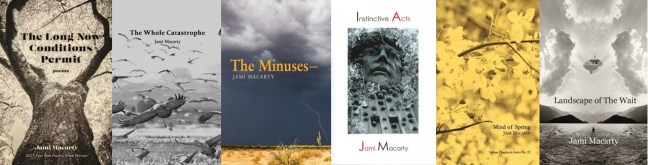
Thank You Bows!

+ Thank you bows (continuous!) to you, dear reader, for the gift of your attention! Welcome, welcome to those of you new to these dispatches on reading and writing books. May you find inspiration for your writer’s life here!

+ Thank you bows (continuous!) to my precious community. To everyone who support my writing, especially women/women-identified writers for not coveting or competing, but sharing and supporting.

+ Thank you bows for supporting The Long Now Conditions Permit (2025): +Bows (continuous!) to my publisher the University of Nevada Press and staff for making my book The Long Now Conditions Permit with me. +Bows (continuous!) to Claudia Keelan and Andrew Nicholson, series editors, and the series board Sherwin Bitsui, Donald Revell, Sasha Steensen, and Ronaldo Wilson of Interim’s Test Site Poetry Series, who selected The Long Now Conditions Permit (University of Nevada Press, December 2025) as the 2023 winner of the Test Site Series Prize. +Bows (continuous!) to Claudia Keelan, Donal Revell, and Ronaldo V. Wilson for offering your word-endorsements! +Bows to Mashiko Kuroki for his luminous tree-woman photo for the cover! +Bows (continuous) to the editors of literary magazines who supported the publication of individual poems from The Long Now Conditions Permit: Geoffrey Gatza at BlazeVOX; Matthew Cooperman at Colorado Review; Haley Lasché at Concision Poetry Journal; Claudia Keelan at Interim: A Journal of Poetry & Poetics; Simone Muench at The Jet Fuel Review; Robert Julius and Alyssa Froehling at The Journal; Charles Kell at Ocean State Review; Richard Greenfield at Puerto del Sol; Jackie Janusis at Redivider; Jaimie Gusman at Tinfish; Eleni Zisimatos at Vallum Magazine and Vallum Chapbook Series; Gillian Conoley at Volt; Sue Goyette, editor of the anthology Resistance: Righteous Rage in the Age of #Metoo (University of Regina Press, 2020).

++ The Minuses ++

Welcome, dear reader! You are most welcome here, where I share information about my and others’ books. Topics such as my reading and reviewing practice, my composition methods, writing and publishing process are taken up here.

The Minuses, my full-length collection, was published in February of this year, so recent posts have focused on what I’m referring to as “the pluses congregating” around The Minuses. Like a constellation of plus (+) signs, reviews, interviews, and readings offered in support of The Minuses shine their positive light and sprinkle sparkling stardust made up of the wondrous generosity of strangers, the special magic of collaboration, and the creative powers of community.

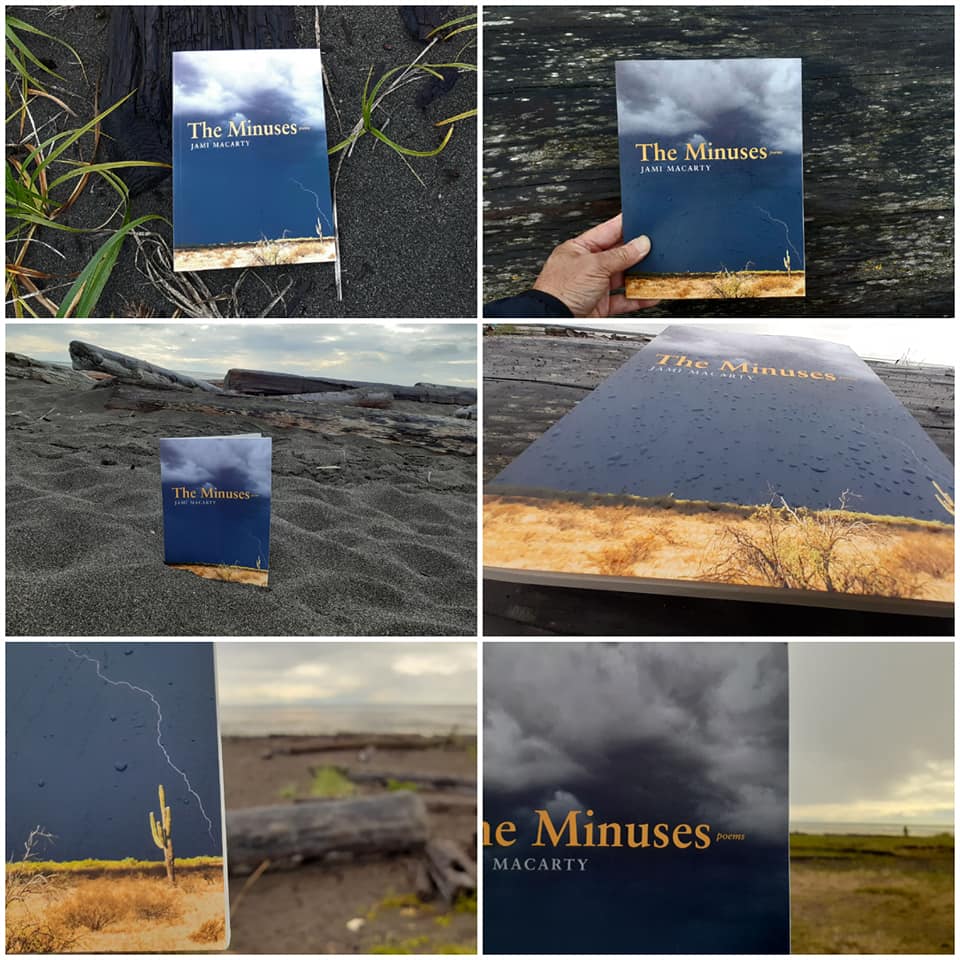
photos and montage created by Vincent K. Wong

Speaking of creative powers, the images and montage of my book above were created by my friend and photographer, Vincent Wong, who also took the author photo on the book’s back cover. Vincent and I met in an Simon Fraser University course I offered in 2012. From that day forward, Vincent has generously shared his creativity with me. He is a front and center collaborator with whom I have expansive art-talk and fun art walks.

Speaking of the generosity of strangers, Holly Mason offered to The Minuses an absolutely gorgeous, close reading-review at Entropy on September 14, 2020. This review sprung into being, in part, from my wondering about reviews, which put to a women’s writers group to which I belong this Q: Does a poet ask, wait, or hope for a review? I was wondering how proactive to be in inviting a review. From that simple gesture of willingness to ask a question, I received an abundance of supportive responses, offering perspective, information, and ideas for actions I could take. This women’s group is amazing! My query also brought to me the lovely Holly Morgan Mason, who said she’d like to offer a review to The Minuses.

Turns out, Holly and I had brushed poetry paths a few years ago. I didn’t remember, but Holly graciously reminded me that our poems had both been finalists in the Real Good Poem Prize, hosted by Rabbit Catastrophe Review. Kiki Petrosino, the prize’s judge, ended up selecting the title poem of The Minuses as prize winner, and in the process began the bringing together of Holly and me to be fulfilled these years later. I love this connection through the years with Holly; it enriches my sense of the potential of community. It’s been a special delight to reconnect with Holly, and an honor to receive the gift of her attention to my poems. Here’s an excerpt from her beautiful review:

The poems in this book are masterfully calibrated. The pacing is slow, careful, meditative throughout. There is space to breathe around the lines. Macarty’s phrasing delights and surprises. Like in the poem “Equals Rain” with the line “We pace the aisle of what happened to the sky.” Or in “Related Sequence” which ends with these stunning and echoing lines: “Loosening September sky// The day feels its own weight and buckles// In a window, a lace dress hangs itself” and ends without punctuation, asking us to consider the implications of the image.

an excerpt of Holly Mason’s review of The Minuses, published in Entropy

Read the entire

Entropy review

by Holly Morgan Mason

here!

: : : :

photos and montage created by Vincent K. Wong

The above montage reveals the sort of artist Vincent is; the sort who takes a desert book to the water! Largely set in the Sonoran Desert, The Minuses dearly appreciates being at the beach, near the water, and in the rain from above. Quenching!

Speaking of being in service of writing community, rob mclennan, invited me to participate in his project 12 or 20 (second series) Questions. My responses were published on September 17, 2020. rob and I have known each other via discussions on first books of poetry since 2008 ish. He’s a deeply engaged and community-minded poetry soul.

rob put to me all 20 of his series’ questions, which spanned topics such as first encounters with poetry, how poems begin, engaging in public readings, theoretical concerns behind my writing, and the role of the poet/poetry. Spending time with these questions, allowed me to contemplate and consider the map my creative life, including coordinates associated with best advice, moving between genres, collaboration, and influence. I’m entirely grateful to rob!

Here’s my response to 12 – When your writing gets stalled, where do you turn or return for (for lack of a better word) inspiration?

For me, it’s not so much that writing stalls. Writing continues, is continuous. Instead, it’s the ego that intervenes and enforces its will on the words. Or, it’s attitude (for me, especially, frustration at how long it’s taking) that gets in the way of the flow and stalls it. I’ve learned (mostly!) to recognize when persistence will be a case of diminishing returns. So, rather than put up my dukes, I take a break. More often than not I go for a walk. Solvitur ambulando! During these times, I don’t have a sense of needing to be inspired, but rather needing to clear a clog or shift attention. Sometimes there’s this sense that what’s unfolding in the writing needs some privacy. So, stepping away, looking away can give it some necessary space. The break has to take place at the energetic, kinesthetic level. Taking a shower, preparing food might also provide space. That’s day to day. Thinking longer term, to meet a sense of staleness, I make visual collages. Often the collages provide an image and color palette for a poem. To bring energy and myself back to words, I invent wild, impossible, contortionist writing constraints that are part goose chase and part scavenger hunt. To meet loneliness, I collaborate with another writer, sending weekly responsive transmissions back and forth. Since September 2019, I and poet, Sean Singer, have been writing a poem together; it’s 36 pages long so far. Or, I may elect to write in community a poem a day with some other poets.

-my response to rob mclennan’s question #12

Read the entire

12 or 20 (second series) Questions

interview

here!

: : : :

+ Thank you bows to lovely person and fine poet Holly Morgan Mason for her gorgeous, full-of-care review of The Minuses; bows also to Entropy and staff for making a place for Holly’s review of my poetry collection.

+ In delightful association, thank you bows to Rabbit Catastrophe Review, the host of the Real Good Poem Prize, and the 2016 prize judge Kiki Petrosino, who selected the title poem of The Minuses as prize winner, and in the process began the bringing together of Holly and me to be fulfilled these years later.

+ Thank you bows to most generous, community-minded rob mclennan for the invitation to participate in his 12 or 20 Questions Series; bows also to rob for his immense support of the poetry community.

+ Thank you bows (continuous!) to publisher Stephanie G’Schwind, and Mountain West Poetry Series editors Donald Revell and Kazim Ali, et al interns at the Center for Literary Publishing (CLP) for making The Minuses with me.

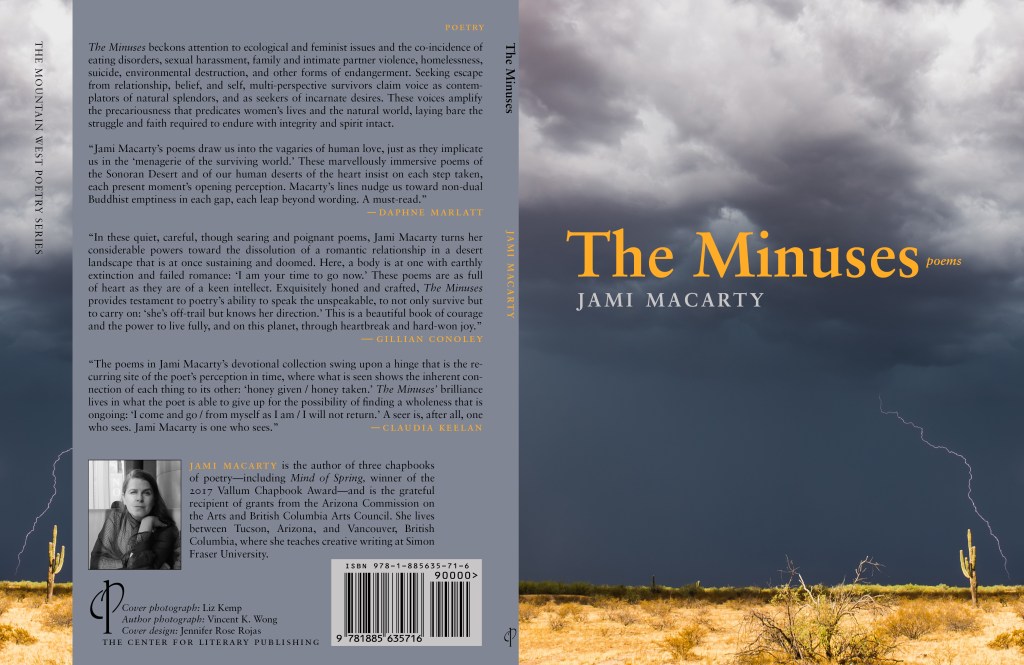
+ Thank you bows (continuous!) to monsoon storm chaser and marvelous professional photographer, Liz Kemp whose monsoon photograph storms the cover of The Minuses.

+ Thank you bows (continuous!) to Vincent K. Wong for his artistic friendship, creative collaboration, and for taking my author photos.

+ Thank you bows (continuous!) to you, dear reader, for the gift of your attention! If you have any questions or comments, write me!

++ THE MINUSES ++

Canadian poet Daphne Marlatt is a plus around The Minuses! I love her poetry and person very much. On and off for the last 15 years, we’ve met for coffee and conversation about poetry and spiritual practice. Our conversations have been sites of candor and infusions of hope.

During the fall of 2018 our exchanges became more frequent. Her wise counsel and cheerful shoulder were of special support to me during the summer of 2019 when I was despairing that The Minuses was still publisher-less.

So, of course on September 3, 2019 (Labor Day!), when I learned from Stephanie G’Schwind that the Center for Literary Publishing wanted to publish The Minuses, Daphne was at the top of my list of those with whom to share the great good news. During that celebratory conversation I asked her if she would endorse my book.

I use the word “endorse” instead of “blurb.” Why? Because “blurb” sounds like spit up to me. I don’t want to associate spit up with my poems. This may be a form of superstition. Poets can be superstitious. I can be superstitious. I’d rather associate enthusiasm with my poems.

Anyway! Daphne said Yes!

After she read The Minuses Daphne sent me a note that included these words, which made my poet’s heart explode in bloom:

Hi Jami,
Well, you have a marvellous ms. here!  I was totally immersed in it.  A blurb has been difficult to word to do it justice…

-Daphne Marlatt

Daphne uses the word “blurb.” So, I looked it up in Merriam-Webster’s Dictionary. I thought its first use would be quite recent. However, the first known use of “blurb” as a noun is 1907, while the first known use of “blurb” as a verb comes eight years later in 1915. The neologism was coined by American humorist Gelett Burgess. I’m not convinced. After typing the word this many times, my stomach is turning. You see? The word has that affect on me. I remain resolute in not using it.

Back and front covers of The Minuses

Here’s the form of enthusiasm Daphne offered for the back cover of The Minuses:

Jami Macarty’s poems draw us into the vagaries of human love, just as they implicate us in the “menagerie of the surviving world.” These marvellously immersive poems of the Sonoran Desert and of our human deserts of the heart insist on each step taken, each present moment’s opening perception. Macarty’s lines nudge us toward non-dual Buddhist emptiness in each gap, each leap beyond wording.  A must-read.

-Daphne Marlatt

I wrote it once, but it’s worth writing again. I love Daphne Marlatt’s poetry. I have loved it for a long time. For me, Daphne’s poetry is a horizon. So, it’s especially special to have her endorsement and energy with me and the poems of The Minuses.

Even though I received the copy of The Minuses earmarked for Daphne in mid-February, travel and Covid-19 postponed our celebratory get-together for months.

On July 13, we finally felt it safe enough to commune at our favored outdoor café, Wilder Snail, for an afternoon coffee and conversationand so that I could bestow on Daphne her copy of The Minuses.

Here’s the photographic record I made of Daphne unwrapping…

The Minuses is unwrapped and Daphne’s mask is off!

Don’t you just love the look on her face?

I do!

That’s my poetry book The Minuses in Daphne Marlatt’s hands!

A poet is happy!

: : : :

+ Thank you bows to Daphne Marlatt for her support to me over these years, for reading The Minuses, and for offering her special words in support of the poems.

+ Thank you bows (continuous!) to publisher Stephanie G’Schwind, editor Donald Revell, et al interns at the Center for Literary Publishing (CLP) for making The Minuses with me.

+ Thank you bows to you, dear reader, for the gift of your attention! If you have any questions or comments, write me!

++ THE MINUSES ++

Dear Reader, an interview is a chance to practice the high art of conversation. A conversation is a plus!

I bring to your attention the June 9, 2020 plus of an interview that the most lovely human and excellent poetry reader, Dayna Patterson conducted with me and The Minuses. Dayna and I met in our conversation on the Poetry Hour (4-5pm PDT) that she hosts for Western C.A.R.E.S. (Community, Activities, Resources, Education, Support) at Western Washington University.

Watch and listen to conversation here (use password: 8Q.A!M.?)

photos and compilation by Vincent K. Wong; background image by Jami Macarty

The Poetry Hour interview took place over Zoom, of course. The photos and compilation above are by Vincent K. Wong, my good pal and a terrific experimental photographer. Vincent attended the event, with 40 other souls, and took these photos of Dayna and me.

I didn’t realize the background image of Sonoran Desert and its saguaro cacti came through and interpentrated the live image of me, shifting foreground and background, the live and the still until Vincent sent me the series of photos he took during the event. I love the photos and the special effects are a perfect visual component to a quality of feeling I’m trying to get at in the poems of The Minuses.

photo by Vincent K. Wong; background image by Jami Macarty

Here are the questions Dayna Patterson asked me during the interview:

  1. We’re here to discuss your recent collection, The Minuses. When I think of the phrase, “the minuses,” I usually hear it in conjunction with “the pluses and the minuses.” With that title holding only the last part of the phrase, I expected that the book would press into themes of loss, negation, and deprivation. It certainly did that, and in ways that surprised me. For example, the book seems to be built from the scrap of a wrecked relationship. Is that an accurate description? Would you read the first piece for us and talk about why you selected this title for your book? 
  2. There’s a lot of verticality in this collection, a motif that in some places conjures, for me, a feeling of vertigo, and in other places a kind of longing to be detached, above the fray, so to speak. How were you working with notions of verticality vs. horizontality in this collection? (Read “Flight Hours,” “Mountain Hypotenuse,” and/or “Nor’easter”)
  3. How and when did you become so intimately acquainted with the landscape of the Sonoran Desert and its environs? What was your research process for the poems in this collection? (Read “Monsoon Desert,” “At Gravity’s Feet,” & “Music 5:30.”) I’m particularly interested in the phrase “I sent myself into the desert to become a third person” in “At Gravity’s Feet.”
  4. Can you talk about the way these poems lean into the colon and the double colon? For you, does the colon represent a kind of mathematical equation rendered into syntax? (Read “By Virtue of And”)
  5. A poem that really resonated for me from this collection is “Door Ratio.” Would you mind reading that one for us?
  6. Your notes section is expansive, specific, and generous. Why include the Latin name for each species you mention in the notes? How do you decide what to put in the notes to a collection?
  7. Is there anything else you’d like to share about the making of this book?
  8. What are you working on now or next?
  9. Who are some of the writers or artists that inspire you? In particular, are there contemporary poets you’d like to recommend to our audience today?

And, here I am endeavoring to arrive at answers, to be responsive.

photo by Vincent K. Wong; background image by Jami Macarty

Dayna’s and my conversation was followed by a Q&A with our audience of listeners and joining souls.

Watch and listen to conversation here (use password: 8Q.A!M.?)

: : : :

+ Thank you bows to Goddess Dayna Patterson for reading The Minuses, for her thoughtful questions, and for featuring and hosting me on the Poetry Hour for Western C.A.R.E.S. at Western Washington University.

+ Thank you bows to Western C.A.R.E.S. at Western Washington University and Goddess Athena Roth for offering her very fine administrative support during the event.

+ Thank you bows to the 40 souls with their beautiful ears and minds who joined me et al for the June 9 interview and conversation.

+ Thank you bows (continuous!) to publisher Stephanie G’Schwind, editor Donald Revell, et al interns at the Center for Literary Publishing (CLP) for making The Minuses with me.

+ Thank you bows to you, dear reader, for the gift of your attention!