! Books !

Dear Gentle Reader,

Hello, may you be healthy, and have had a marvelous summer. Happy Autumn!

Welcome back to my dispatches about making and reading books!

When I wrote to you in June, I was preparing to proofread the galley for my fourth chapbook The Whole Catastrophe. Galley v.1 arrived via electronic file, I printed it, then served the document’s pages to myself at the dining table where I commenced reading from the blue and white layered over a purple straw placemats with my chosen implements: a No. 2 pencil, a pink highlighter, and a TUL pen in purple.

From June 19 to July 17, Series Editor Eleni Zisimatos, Designer Leigh Kotsidilis, and I formed an editorial team of three patient souls devoted to preparing an error-free, print-ready manuscript of The Whole Catastrophe. We read and corrected. We took a break and awaited the bibliographic record for the Library of Congress (CiP data) and International Standard Book Number (ISBN). We fiddled with the front and back coversr. We read again and corrected again until we caught all of the niggly typesetting bits and pieces that went wonky when my Word file was transferred to a chapbook file. On July 9, the CiP data and ISBN arrived. On July 12, we finalized Rosie Long Decter’s attentive words (below) for the back cover. On July 17, we made the last line break correction to v.5. Et, Fin!

Publication Announcement
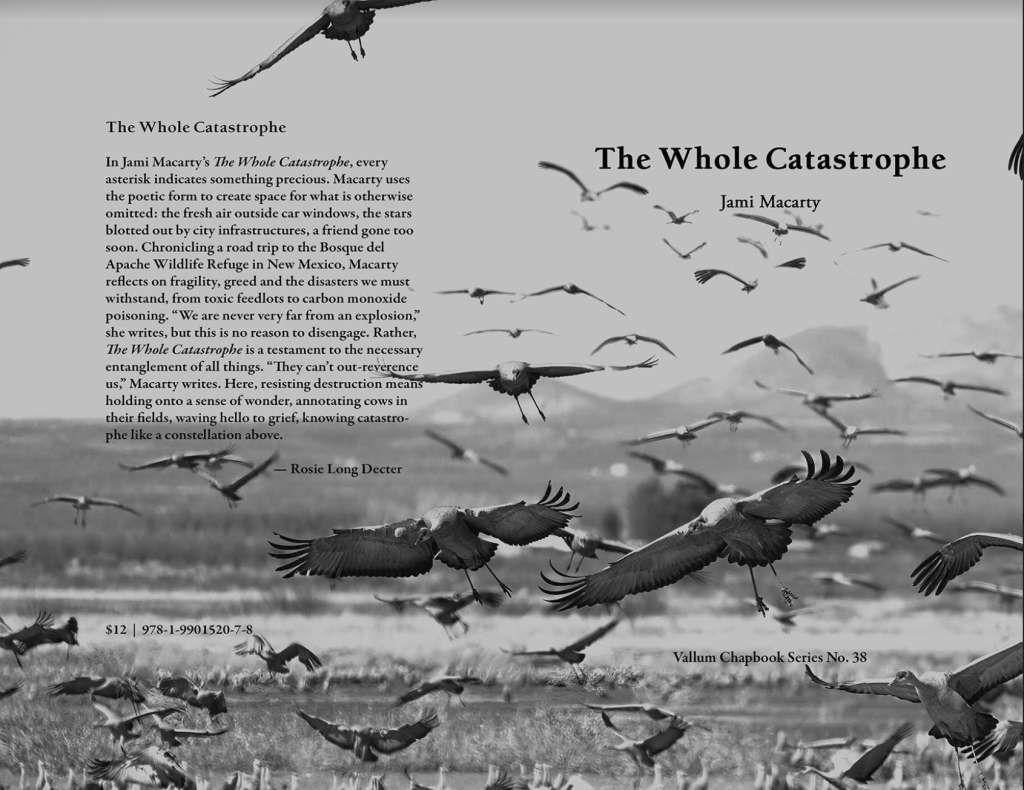
THE WHOLE CATASTROPHE
Vallum Chapbook Series No. 38
Jami Macarty

The Endorsement of Rosie Long Decter

In Jami Macarty’s The Whole Catastrophe, every asterisk indicates something precious. Macarty uses the poetic form to create space for what is otherwise omitted: the fresh air outside car windows, the stars blotted out by city infrastructures, a friend gone too soon. Chronicling a road trip to the Bosque del Apache Wildlife Refuge in New Mexico, Macarty reflects on fragility, greed and the disasters we must withstand, from toxic feedlots to carbon monoxide poisoning. “We are never very far from an explosion,” she writes, but this is no reason to disengage. Rather, The Whole Catastrophe is a testament to the necessary entanglement of all things. “They can’t out-reverence us,” Macarty writes. Here, resisting destruction means holding onto a sense of wonder, annotating cows in their fields, waving hello to grief, knowing catastrophe like a constellation above.

— Rosie Long Decter

Hurrah, Rosie and her endorsement! I especially love “a testament to the necessary entanglement of all things” for these words get at the soul of the poems in The Whole Catastrophe. Poetry Love!

Sandhill Cranes Incoming, February 7, 2024
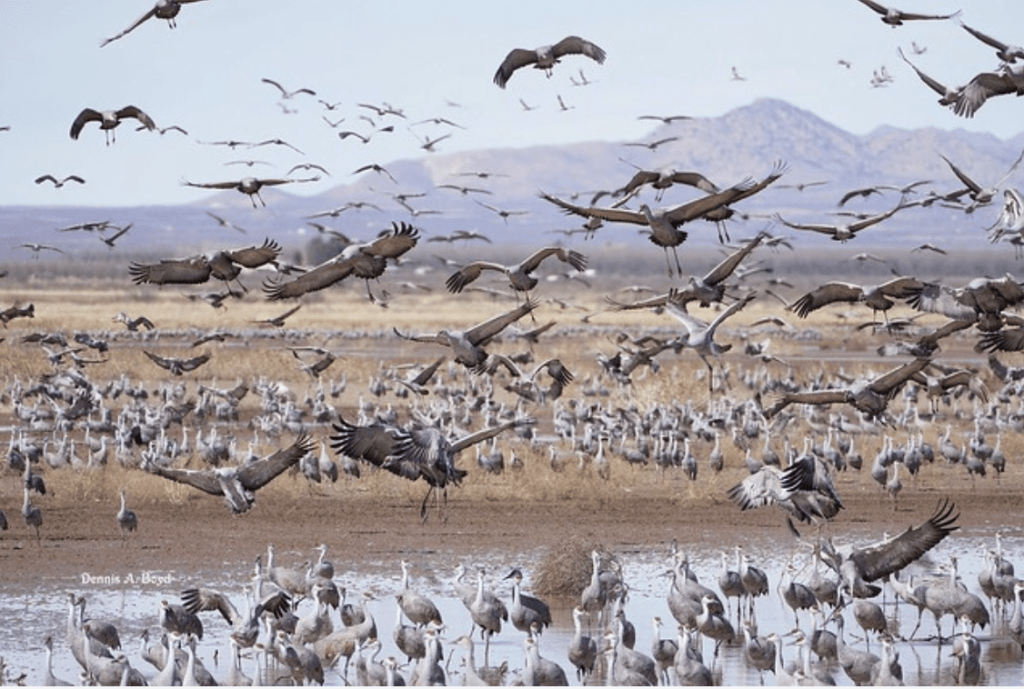
The first time I saw Dennis A. Boyd‘s full-color photograph of Sandhill Cranes at Arizona’s Whitewater Draw Wildlife Area (above) was on February 7, 2024 in a Facebook group of Arizona photographers. My heart took flight and my mind wilded. Every time I see Dennis’s gorgeous photograph, I am overcome. Something within in me mends. So, the moment I first saw Dennis’s photograph I knew it had to accompany the poems of The Whole Catastrophe which feature both Sandhill Cranes and Whitewater Draw. Hurrah, Dennis A. Boyd for agreeing to accompanying my art with his. Bird love!

I want to take you to Whitewater Draw Wildlife Area, one of my favorite places on Earth. From October to March, Whitewater Draw is a crucial roost site for migrating Sandhill Cranes (stock image, right). Some 20,000 thousand Sandhill Cranes overwinter at the Wildlife Area where they wade flooded fields and nibble corn stubble. They are typically joined by thousands of Snow and Ross’s Geese, among other migrating waterfowl. The cranes are an elegant sight to see and uproarious orchestra to hear! To get a sense of what it is to be in the presence of this many Sandhill Cranes, and to hear them, tune in to this two-minute video of Sandhill Cranes at Whitewater Draw recorded on January 26, 2024 by Arizona Game and Fish.
Now, let me tell me a bit about the poems in The Whole Catastrophe. The chapbook is comprised of three poems that mix documentary, elegiac, and ecological poetics attendant to the precariousness of our human and earthly lives. “Allowing for Betweens,” one of two long poems in the chapbook, records a roadtrip to Bosque del Apache National Wildlife Refuge in New Mexico and grieves the shocking death of a dear friend. A Mesostic poem, a type of acrostic poem invented by John Cage, celebrates the thousands of overwintering Snow Geese and Sandhill Cranes at Bosque del Apache. The chapbook closes with the title poem, a celebration of the ecstatic between lovers on a camping trip and a pledge of allegiance to wild lands.

I would love for you to read The Whole Catastrophe! I would love to know your reader’s response to the poems. Would you like to read The Whole Catastrophe? If so, you can purchase a copy from Vallum. Or, if you would like a signed copy, purchase one directly from me. I would be ever grateful to you for your best-of-all book-buying support. Contact me via a comment or email. xo

Forthcoming! Forthcoming!

  • Soon, on behalf of Vallum, T. Liem will be interviewing me about the composition of the three poems in The Whole Catastrophe.
  • Soon, Interim – A Journal of Poetry and Poetics (Since 1944!) will be publishing their “Finalist Issue,” featuring the semifinalists, finalists, and winners for the Test Site Poetry Series prize. That issue will feature some poems from my Test Site prize-winning manuscript The Long Now Conditions Permit (forthcoming University of Nevada Press). Included in the issue will also be one of the poems from The Whole Catastrophe (#38, Vallum Chapbook Series, 2024)…

: :

The Pluses!

+ Thank you bows (continuous!) to you, dear reader, for the gift of your attention! Welcome, welcome to those of you new to these dispatches on reading and writing books. May you find inspiration for your writer’s life!

+ Thank you bows to my community of women/women-identified writers for their generous, loving support, inspiration, and encouragement.

+ Thank you bows to Vallum Chapbook Series and Eleni Zisimatos, Editor, and Leigh Kotsilidis, Designer, for making my chapbook The Whole Catastrophe (2024) with me.

+ I bow to the editors who support my reviews and the publications where they were published: Denise Hill at NewPages; Stephanie G’Schwind at Colorado Review, and Jay Ruzesky at The Malahat Review.

+ I bow to Claudia Keelan and Andrew Nicholson, series editors, and the series board Sherwin Bitsui, Donald Revell, Sasha Steensen, and Ronaldo Wilson of Interim’s Test Site Poetry Series, who selected The Long Now Conditions Permit (forthcoming University of Nevada Press).

+ Thank you bows (continuous!) to my publisher Stephanie G’Schwind, and Mountain/West Poetry Series editors Donald Revell and Kazim Ali, et al interns at the Center for Literary Publishing (CLP) for making The Minuses (2020) with me.

+ Thank you bows (continuous!) to Beth Svinarich et al staff at University Press of Colorado for their beautiful support to me and The Minuses.

+ Thank you bows (continuous!) to monsoon storm chaser and marvelous professional photographer, Liz Kemp, whose monsoon photograph storms the cover of The Minuses.

+ Thank you bows to Nomados Literary Publishers, Meredith and Peter Quartermain for making my chapbook Instinctive Acts (2018)with me.

+ Thank you bows to Vallum Chapbook Series and editors Leigh Kotsilidis and Eleni Zisimatos for making my chapbook Mind of Spring (2017) with me.

+ Thank you bows to Finishing Line Press and editors Leah Maines and Christen Kinkaid for making my chapbook Landscape of The Wait (2017) with me.

+ Thank you bows (continuous!) to Vincent K. Wong for his friendship, creative collaboration, and for taking my author photos.

+ This bears repeating: Thank you bows (continuous!) to you, dear reader, for the gift of your attention! If you have any questions or comments, write me! I would love to hear from you!

! BOOKS !

Dear Gentle Reader,

Hello, and may your new year be off to a bright, shiny start! I have been making it a practice to note what shines in each day—sunrise pinking the sky, house sparrows conversing, receiving a postcard from a friend, discovering a long-sought book in a used bookstore, sweet deep purple hyacinths, walking beside bodies of water, sun’s setting mauves—breathing in the color, sound, texture, weight, and scent of the felt world and allowing the world to affect me. I think this sensorial exchange is, in part, what it means to be a writer.

In these first weeks of 2024, my life as a poet, editor, reviewer, and teacher has been alive with possibility and response.

Ocean State Review is currently featuring my poem “Asterisk to What Branches to the Perfect Including,” along with a note on the poem’s collaborative beginnings during the early months of the pandemic. You are cordially invited to read the poem and my note on how the poem came to be.

In January, the manuscript for my second collection of poems was named one of fourteen semifinalists for the Test Site Poetry Series and Besty Joiner Flanagan Award in Poetry. And, on the second day of February, the manuscript was named one of ten finalists for these two prizes! How can I tell you what these acknowledgments mean to the life of this poet? Wings. Lift. Flight.

Once I return to Earth, this acknowledgment hurries me to the page. So, I joined The Stafford Challenge to write a poem a day this year! The Challenge is inspired by William Stafford (1914-1993), who made a practice of crafting a poem daily. Here is one of his poems: “Traveling Through the Dark.” As my newborn poems take their first breaths, I have also been tinkering with the poems in my fourth chapbook, forthcoming from the Vallum Chapbook Series in the summer. I also sent out writing for consideration and received three no-thank-yous. Breathe in and out; that is the process.

As well as write a poem a day this year, I plan to continue #mypersonalBigRead project. I started this project in 2018 to challenge myself to develop a consistent reading practice, trying for a book a day. I read twenty-one books in January.

One of those books was a manuscript of a first novel by a writer dedicated to her writing dreams. What this fiction writer has accomplished is an example of intention and perseverance. During the past three years, this writer and I worked together to bring three short stories to life and then publication. Then, having proved what she could accomplish in short-form fiction, she channeled her momentum into writing a novel. She had carried the idea for that novel in her head for years. It was time. For a year she kept her butt in a chair at her desk and wrote the novel of her dreams. And, in January, I had the pleasure of offering editorial commentary on her five-hundred-page first novel! Our mentoring relationship has been super gratifying, and it has been inspiring to be a part of this writer’s process. Intention and perseverance: Two necessaries for a writer.

As a teacher, I have been planning another iteration of Write, Write, Write, the five-day all-genre writing course designed to get writers writing, offered online at Simon Fraser University. I and the fiction writer above first met in Write, Write, Write. She built momentum by enthusiastically and fully engaging in the course, availing herself of everything the readings and writing practices and I had to offer. Dear writer, you could do the same! Write, Write, Write starts on February 10 and goes until February 14, 2024. Might this five-day course be your writer’s valentine to yourself?

From my teaching and mentoring practices emerges gratification and inspiration. From my reading reviews sometimes emerge. My long-form review of Kate Cayley’s poetry collection Lent (Book*hug, 2023) was published in The Malahat Review Winter Issue #225. In January, I wrote two short-form reviews of poetry chapbooks. My reviews of Maya Clubine’s Life Cycle of a Mayfly (Vallum Chapbook Series, 2023) and Sarah Rosenthal’s We Could Hang a Radical Panel of Light (Drop Leaf Press, 2022) are forthcoming at NewPages.com. So far in February, I have written reviews of Emily Hockaday’s In a Body (Small Harbor Publishing, 2023) and Tina Carlson’s A Guide to Tongue Tie Surgery, two full-length poetry collections. These reviews are also forthcoming at NewPages.com.

From writing emerges, poems, reviews, novels, editing, publications, and invitations. I have accepted an invitation to read at the celebration of the Cascadia Zen: Bioregional Writing on Cascadia Here and Now (Watershed Press, 2023). The reading will take place at Vancouver’s People’s Co-op Books on April 20; I will read my poem from the anthology. I have also agreed to read for Vancouver’s Dead Poets Reading Series in the fall.

I think of my life as a writer as a feast. There is no famine; writing is endlessly giving. I celebrate the times of private conversation between me and the page, the page and the word, the word and language. And, I celebrate when that conversation expands to include magazine editors, book publishers, award judges, fiction writers, poetry writers, and event organizers—the precious-to-me people who respond to what I write, edit, and teach. Hurrah my alive weeks as a poet, editor, reviewer, and teacher!

Tell me about your life as a writer. Tell me, what is shining in your day? Send your comments below.

: :

The Pluses!

+ Thank you bows (continuous!) to you, dear reader, for the gift of your attention! Welcome, welcome to those of you new to these dispatches on reading and writing books. May you find inspiration for your writer’s life!

+ Thank you bows to my community of women/women-identified writers for their generous, loving support, inspiration, and encouragement.

+ I bow to the editors and the existence of the anthologies and literary magazines, such as Cascadia Zen: Bioregional Writing on Cascadia Here and Now (Watershed Press, 2023) and The Ocean State Review where I gratefully find support and community.

+ I bow to the editors and the existence of publishers of poetry, such as Interim’s Test Site Poetry Series and the Besty Joiner Flanagan Award in Poetry.

+ I bow to the editors who support my reviews and the publications where they were published: Denise Hill at NewPages; Manahil Bandukwala at Canthius; James M. Fisher at The Miramachi Reader, and Jay Ruzesky at The Malahat Review.

+ Thank you bows (continuous!) to my publisher Stephanie G’Schwind, and Mountain/West Poetry Series editors Donald Revell and Kazim Ali, et al interns at the Center for Literary Publishing (CLP) for making The Minuses (2020) with me.

+ Thank you bows (continuous!) to Beth Svinarich et al staff at University Press of Colorado for their beautiful support to me and The Minuses.

+ Thank you bows (continuous!) to monsoon storm chaser and marvelous professional photographer, Liz Kemp, whose monsoon photograph storms the cover of The Minuses.

+ Thank you bows to Nomados Literary Publishers, Meredith and Peter Quartermain for making my chapbook Instinctive Acts with me.

+ Thank you bows to Vallum Chapbook Series and editors Leigh Kotsilidis and Eleni Zisimatos for making my chapbook Mind of Spring with me.

+ Thank you bows to Finishing Line Press and editors Leah Maines and Christen Kinkaid for making my chapbook Landscape of The Wait with me.

+ Thank you bows (continuous!) to Vincent K. Wong for his friendship, creative collaboration, and for taking my author photos.

+ This bears repeating: Thank you bows (continuous!) to you, dear reader, for the gift of your attention! If you have any questions or comments, write me! I would love to hear from you!

! BOOKS !

Hello to you in this bright, shiny new year, dear Readers!

Here I am to share news and reflections about books—the making and reading and reviewing of books.

Several of the posts I offered last year focused on the happiness surrounding the publication of individual poems, and many of those publications were of poems within my second collection, The Long Now Conditions Permit, which was a 2022 finalist for the Test Site Poetry Series. To learn where the poems appear or are forthcoming, visit my website’s Poet page and/or take a spin through last year’s posts: October 31, 2022; August 25, 2022; June 15, 2022; May 29, 2022; April 28, 2022; February 5, 2022.

In this first post of 2023, allow me to share with you two publications which closed out 2022, wrapping the year up with a lovely loveliness. First up, The Capilano Review 50th Anniversary three-volume glossary. My writing appears in volume three under S for Space.

Space & the Unworded within (My) Poems, my hybrid writing—part poem, part poetics essay, part treatise, part je ne sais quois—on how space is enacted within my poems appears in Issue 3.48 (Fall 2022) of The Capilano Review 50th Anniversary three-volume glossary. Below, the treatise’s opening pages.

Allow me to share a bit about how this writing came into being. In July 2020, I drafted a poem-a-day in community. A lifeline during the pandemic! As per my usual, many of those poems were showing up inhabiting the space of the page differently from the majority of other poems in a columnar form which hugged the left margin. About midway through, “space” came to the attention of someone else in the group and that poet inquired:

“I am wondering about spacing in the poetry. I see a lot of poems with seemingly arbitrary spacing. If the poet has a reason to use it, it often escapes me. But I see it a lot, so I think I’m missing some important points.”

Since as far as I could tell, I was the only one using the space of the page in the group, I took these questions as a sort of prompt and wrote the beginnings of a treatise on how I conceive of and the enact space on the page, which I offered to the community:

“Dear Companion Poetic Line-breakers & Space-makers,

I’ve made some notes and offer you a nut-graph of sorts on the thinking that arises regarding space, spacing, etc.” 

Positive feedback for what I wrote encouraged me to develop the treatise, and to see if I could get it published. I had it in mind for a call at The Capilano Review. While those lovely editors did not think it was a fit for that call, they did think it was a fit for the three-volume experimental glossary that they were planning to celebrate the 50th anniversary of The Capilano Review in 2022. My treatise was a non-brainer fit in the third volume under the letter S for space. I was thrilled! Still am! The writing of the treatise has been a gift and a teacher. It was sort of magical how it all came to be, and I’m grateful for that poet’s initial questions which got me space-travelling, and also to those who read the piece and offered encouragement. Questions and encouragement: a delicious recipe for my making and writing!

There is more! My poetics treatise was inspiration for the event: A Partly Common Language: Roundtable on the Poetics Essay, which the smart, thoughtful people at The Capilano Review organized to launch Issue 3.48 (Fall 2022).

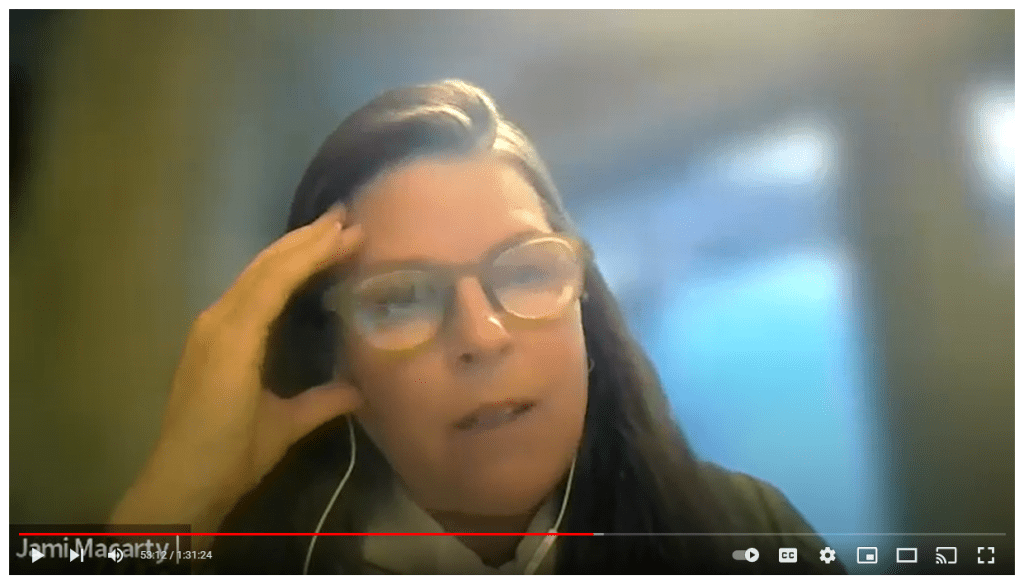
Above, my typical thinking gesture in freeze-frame. To hear me read from my treatise on space and the entire November 17 roundtable, which includes the incomparable Nicole Brossard, along with Stephen Collis, Larissa Lai, Jami Macarty, and D.S. Marriott, go to The Capilano Review YouTube channel and look for A Partly Common Language: Roundtable on the Poetics Essay (or click on the title).

::

The last publication of 2022 was of my poem “The Fourth Leaf,” a poem from The Long Now Conditions Permit, which appeared in Redivider 19.2. Visit the Redivider website to read the entire poem.

I have long-admired Redivider, so it was especially gratifying for me that the editors gave a home to one of my poems. And now, I include, and am included in, the Redivider community.

Community, expanding concentric outward circles was a theme for and a gift of 2022. I am grateful to my poems for connecting me anew to communities and editors who have supported my writing from early on, and also with new communities. All in all it was a terrifically exciting year for this poet!

::

Some 2022 Year-End Tallies:

Chances, Publications, and Rejections. As I shared above, twenty-three poems were accepted for publication. Add to that one poetics essay for twenty-four acceptances. Of those, sixteen poems and one essay were published in 2022. The additional seven poems are forthcoming this year—something to look forward to in 2023! I also await decisions on fifteen more chances to be accepted for publication that are still alive.

2022 was the best year ever for me/my writing on the publishing of individual poems front. How do I account for that? Simple. I sent my writing out for consideration more than I ever have before. I took about 130 chances to get published individual poems, a fourth chapbook, a second book, and to be awarded grants or residencies. Enough to receive 138 rejections, though some of those come from the chances I took in 2021. That is how! And, I joined a group of women writers who strive for 100 rejections in the year. They were my spur and support. The exercise was immunity building. Also, community building.

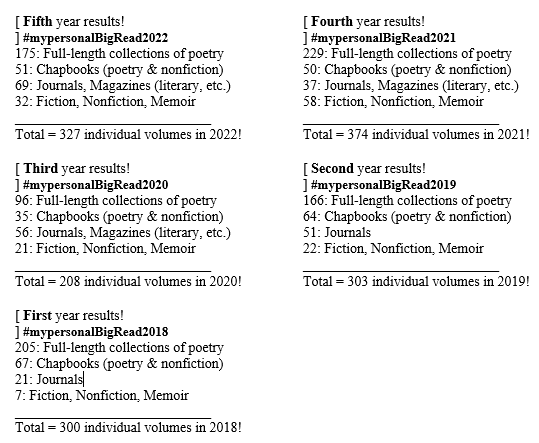
Book tallies. #mypersonalBigRead2022. Started in 2018, last year was my fifth year of reading how much I can read. How much did I read in 2022? 327 volumes, comprised of:      

175: Full-length collections of poetry
51: Chapbooks (poetry & nonfiction)
69: Journals, Magazines (literary, etc.)
32: Fiction, Nonfiction, Memoir
____________________________
Total = 327 individual volumes in 2022!

Last year, I concentrated on reading a many-year backlog of literary journals and magazines—some from the 1990s! Some of the older magazines were like time capsules, allowing me to gain perspective on how both certain magazines used to be as well as how poetry and fiction used to be. That was fun! I made many new-old discoveries, read some writers’ beginnings, and went down some rabbit holes. I learned a ton and plumped up my respect and appreciation for literary magazines, particularly Beloit Poetry Journal, Denver Quarterly, Fence, and Vallum.

Onward to my sixth year of reading! I am 32 books into my #mypersonalBigRead2023. Below, the previous five years’ tallies of 1,512 books, so you can take a look:

Book tallies. Reviews. I offered reviews to 20 books in 2022. Mostly volumes of poetry inspired me to write something about my experience of reading them. Some full-length collections, some chapbooks, some hybrid books. I am particularly chuffed about the following reviews:

Why am I chuffed? I have the feeling of getting close to what I most wanted to say about these books in these longer-form reviews. You are most cordially invited to take a look. The links to all of the reviews I offered last year are available on this website; toggle to my site’s Poet page, where you will find the entire list of reviews.

::

The Pluses!

+ Thank you bows (continuous!) to you, dear reader, for the gift of your attention!

+ Thank you bows to my community of women/women-identified writers for their generous, loving support, inspiration, and encouragement.

+ Thank you bows to Editorial Director Matea Kulić, Literary Editor Deanna Fong, and Art Editor Jacquelyn Zong-Li Ross at The Capilano Review for giving attention and page-space to my poetics treatise-essay “Space & the Unworded in (My) Poems” and for their continuous support of my writing.

+ Thank you bows to good people at Redivider for their support of my writing/making practice and for giving a home to “The Fourth Leaf.”

+ I bow to the existence of The Capilano Review and Redivider, where I find community.

+ I bow to the editors, who supported my reviews and the publications where they were published: Denise Hill at NewPages; Jacquelyn Zong-Li Ross at The Capilano Review; Manahil Bandukwala at Canthius; James M. Fisher at The Miramachi Reader.

+ I bow to each and every author of each and every poem and story I read in 2022! Thank you for your company!

+ Thank you bows (continuous!) to my publisher Stephanie G’Schwind, and Mountain West Poetry Series editors Donald Revell and Kazim Ali, et al interns at the Center for Literary Publishing (CLP) for making The Minuses (2020) with me.

+ Thank you bows (continuous!) to Beth Svinarich et al at University Press of Colorado for their beautiful support to me and The Minuses.

+ Thank you bows (continuous!) to monsoon storm chaser and marvelous professional photographer, Liz Kemp whose monsoon photograph storms the cover of The Minuses.

+ Thank you bows to Nomados Literary Publishers, Meredith and Peter Quartermain for making my chapbook Instinctive Acts with me.

+ Thank you bows to Vallum Chapbook Series and editors Leigh Kotsilidis and Eleni Zisimatos for making my chapbook Mind of Spring with me.

+ Thank you bows to Finishing Line Press and editors Leah Maines and Christen Kinkaid for making my chapbook Landscape of The Wait with me.

+ Thank you bows (continuous!) to Vincent K. Wong for his friendship, creative collaboration, and for taking my author photos.

+ This bears repeating: Thank you bows (continuous!) to you, dear reader, for the gift of your attention! If you have any questions or comments, write me! I would love to hear from you!
++ THE MINUSES ++

Canadian poet Daphne Marlatt is a plus around The Minuses! I love her poetry and person very much. On and off for the last 15 years, we’ve met for coffee and conversation about poetry and spiritual practice. Our conversations have been sites of candor and infusions of hope.

During the fall of 2018 our exchanges became more frequent. Her wise counsel and cheerful shoulder were of special support to me during the summer of 2019 when I was despairing that The Minuses was still publisher-less.

So, of course on September 3, 2019 (Labor Day!), when I learned from Stephanie G’Schwind that the Center for Literary Publishing wanted to publish The Minuses, Daphne was at the top of my list of those with whom to share the great good news. During that celebratory conversation I asked her if she would endorse my book.

I use the word “endorse” instead of “blurb.” Why? Because “blurb” sounds like spit up to me. I don’t want to associate spit up with my poems. This may be a form of superstition. Poets can be superstitious. I can be superstitious. I’d rather associate enthusiasm with my poems.

Anyway! Daphne said Yes!

After she read The Minuses Daphne sent me a note that included these words, which made my poet’s heart explode in bloom:

Hi Jami,
Well, you have a marvellous ms. here!  I was totally immersed in it.  A blurb has been difficult to word to do it justice…

-Daphne Marlatt

Daphne uses the word “blurb.” So, I looked it up in Merriam-Webster’s Dictionary. I thought its first use would be quite recent. However, the first known use of “blurb” as a noun is 1907, while the first known use of “blurb” as a verb comes eight years later in 1915. The neologism was coined by American humorist Gelett Burgess. I’m not convinced. After typing the word this many times, my stomach is turning. You see? The word has that affect on me. I remain resolute in not using it.

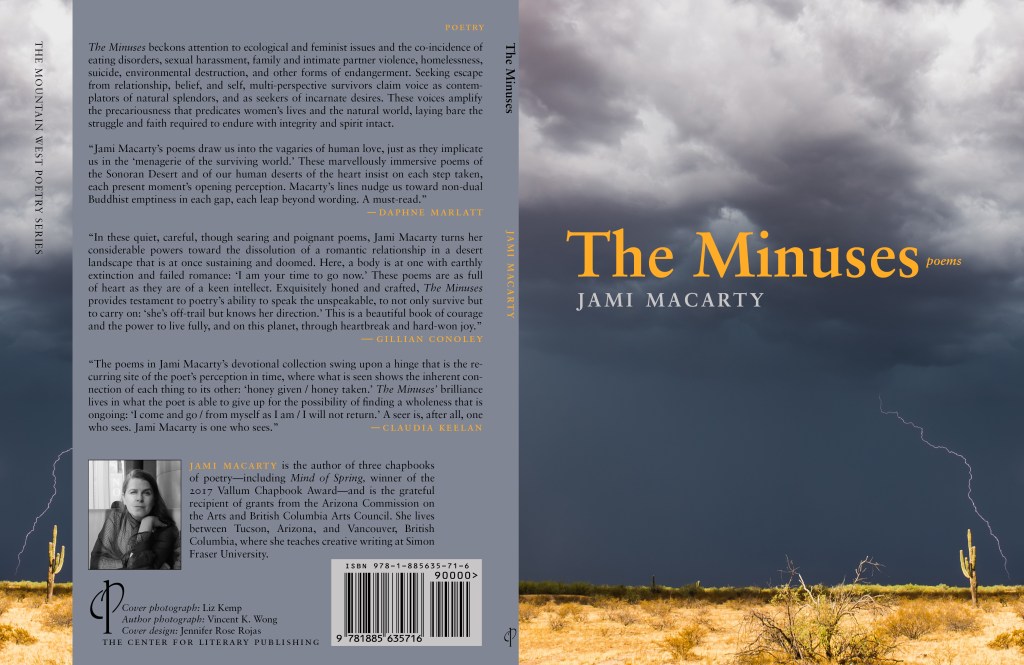
Back and front covers of The Minuses

Here’s the form of enthusiasm Daphne offered for the back cover of The Minuses:

Jami Macarty’s poems draw us into the vagaries of human love, just as they implicate us in the “menagerie of the surviving world.” These marvellously immersive poems of the Sonoran Desert and of our human deserts of the heart insist on each step taken, each present moment’s opening perception. Macarty’s lines nudge us toward non-dual Buddhist emptiness in each gap, each leap beyond wording.  A must-read.

-Daphne Marlatt

I wrote it once, but it’s worth writing again. I love Daphne Marlatt’s poetry. I have loved it for a long time. For me, Daphne’s poetry is a horizon. So, it’s especially special to have her endorsement and energy with me and the poems of The Minuses.

Even though I received the copy of The Minuses earmarked for Daphne in mid-February, travel and Covid-19 postponed our celebratory get-together for months.

On July 13, we finally felt it safe enough to commune at our favored outdoor café, Wilder Snail, for an afternoon coffee and conversationand so that I could bestow on Daphne her copy of The Minuses.

Here’s the photographic record I made of Daphne unwrapping…

The Minuses is unwrapped and Daphne’s mask is off!

Don’t you just love the look on her face?

I do!

That’s my poetry book The Minuses in Daphne Marlatt’s hands!

A poet is happy!

: : : :

+ Thank you bows to Daphne Marlatt for her support to me over these years, for reading The Minuses, and for offering her special words in support of the poems.

+ Thank you bows (continuous!) to publisher Stephanie G’Schwind, editor Donald Revell, et al interns at the Center for Literary Publishing (CLP) for making The Minuses with me.

+ Thank you bows to you, dear reader, for the gift of your attention! If you have any questions or comments, write me!