Dear Gentle Reader,
Hello, may you be healthy, and have had a marvelous summer. Happy Autumn!
Welcome back to my dispatches about making and reading books!
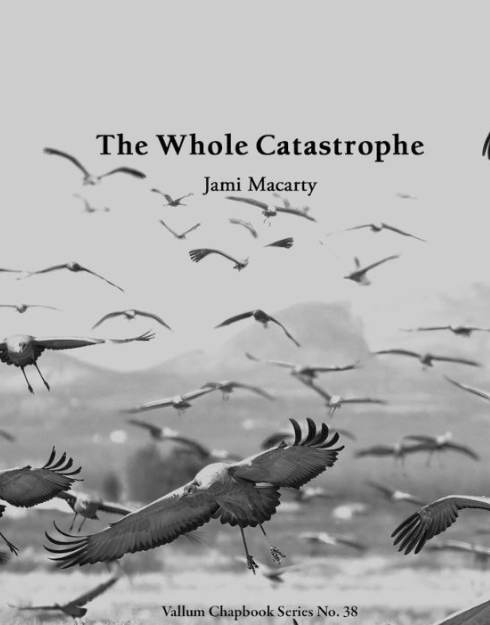
When I wrote to you in June, I was preparing to proofread the galley for my fourth chapbook The Whole Catastrophe. Galley v.1 arrived via electronic file, I printed it, then served the document’s pages to myself at the dining table where I commenced reading from the blue and white layered over a purple straw placemats with my chosen implements: a No. 2 pencil, a pink highlighter, and a TUL pen in purple.

From June 19 to July 17, Series Editor Eleni Zisimatos, Designer Leigh Kotsidilis, and I formed an editorial team of three patient souls devoted to preparing an error-free, print-ready manuscript of The Whole Catastrophe. We read and corrected. We took a break and awaited the bibliographic record for the Library of Congress (CiP data) and International Standard Book Number (ISBN). We fiddled with the front and back coversr. We read again and corrected again until we caught all of the niggly typesetting bits and pieces that went wonky when my Word file was transferred to a chapbook file. On July 9, the CiP data and ISBN arrived. On July 12, we finalized Rosie Long Decter’s attentive words (below) for the back cover. On July 17, we made the last line break correction to v.5. Et, Fin!
Publication Announcement
THE WHOLE CATASTROPHE
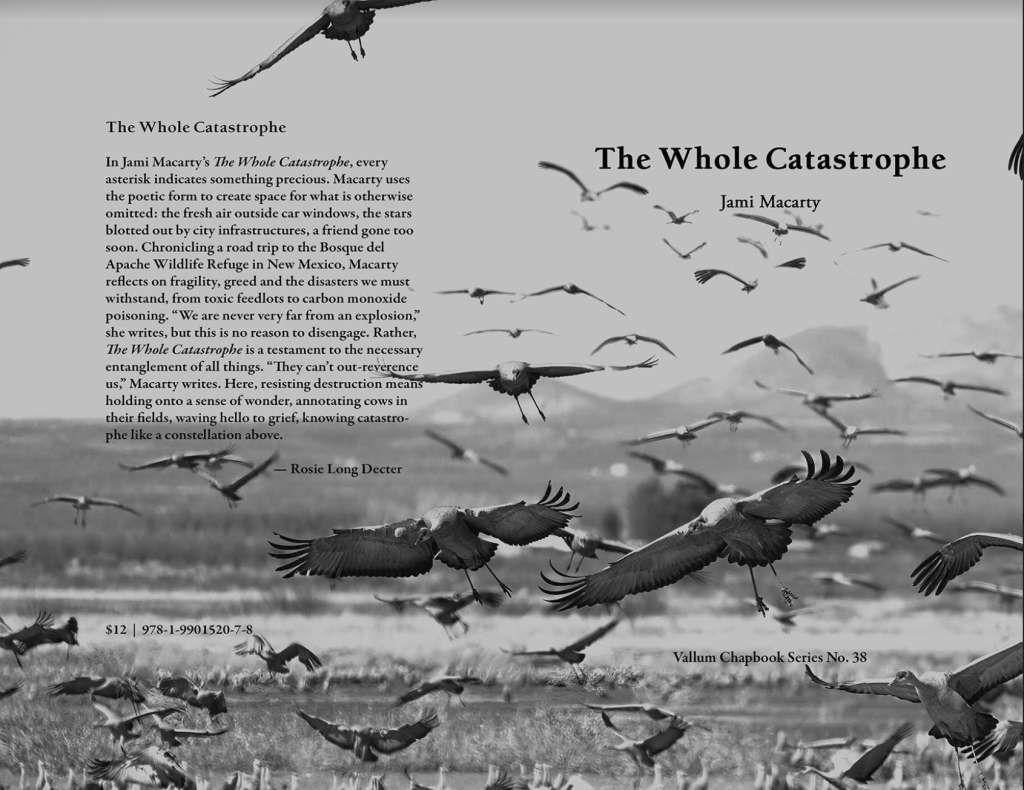
Vallum Chapbook Series No. 38
Jami Macarty
The Endorsement of Rosie Long Decter
In Jami Macarty’s The Whole Catastrophe, every asterisk indicates something precious. Macarty uses the poetic form to create space for what is otherwise omitted: the fresh air outside car windows, the stars blotted out by city infrastructures, a friend gone too soon. Chronicling a road trip to the Bosque del Apache Wildlife Refuge in New Mexico, Macarty reflects on fragility, greed and the disasters we must withstand, from toxic feedlots to carbon monoxide poisoning. “We are never very far from an explosion,” she writes, but this is no reason to disengage. Rather, The Whole Catastrophe is a testament to the necessary entanglement of all things. “They can’t out-reverence us,” Macarty writes. Here, resisting destruction means holding onto a sense of wonder, annotating cows in their fields, waving hello to grief, knowing catastrophe like a constellation above.
— Rosie Long Decter

Hurrah, Rosie and her endorsement! I especially love “a testament to the necessary entanglement of all things” for these words get at the soul of the poems in The Whole Catastrophe. Poetry Love!
Sandhill Cranes Incoming, February 7, 2024
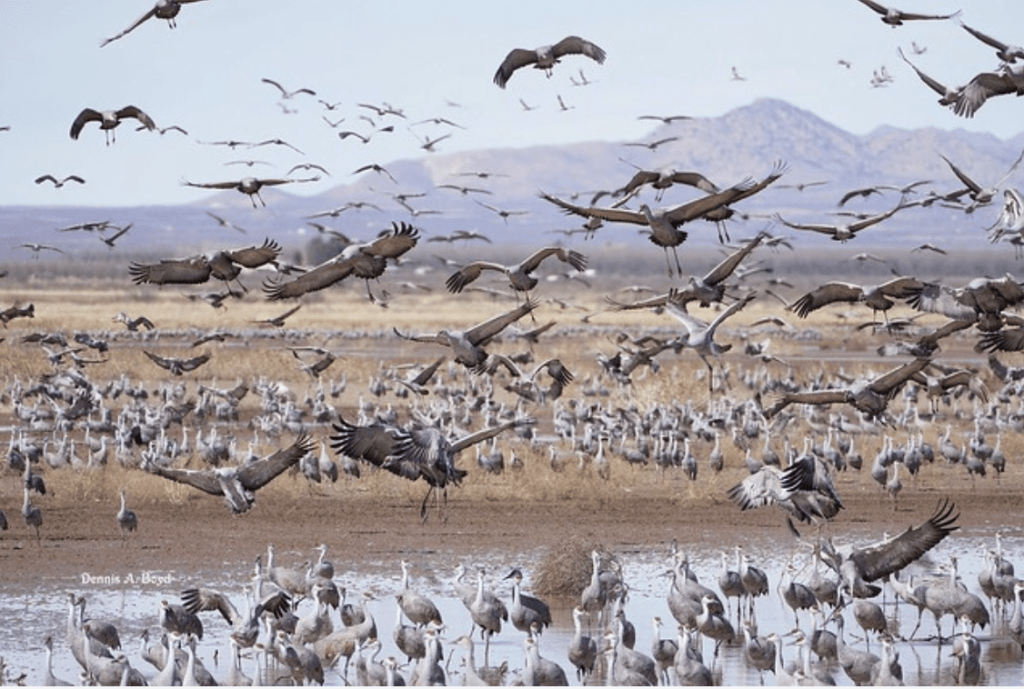
The first time I saw Dennis A. Boyd‘s full-color photograph of Sandhill Cranes at Arizona’s Whitewater Draw Wildlife Area (above) was on February 7, 2024 in a Facebook group of Arizona photographers. My heart took flight and my mind wilded. Every time I see Dennis’s gorgeous photograph, I am overcome. Something within in me mends. So, the moment I first saw Dennis’s photograph I knew it had to accompany the poems of The Whole Catastrophe which feature both Sandhill Cranes and Whitewater Draw. Hurrah, Dennis A. Boyd for agreeing to accompanying my art with his. Bird love!

I want to take you to Whitewater Draw Wildlife Area, one of my favorite places on Earth. From October to March, Whitewater Draw is a crucial roost site for migrating Sandhill Cranes (stock image, right). Some 20,000 thousand Sandhill Cranes overwinter at the Wildlife Area where they wade flooded fields and nibble corn stubble. They are typically joined by thousands of Snow and Ross’s Geese, among other migrating waterfowl. The cranes are an elegant sight to see and uproarious orchestra to hear! To get a sense of what it is to be in the presence of this many Sandhill Cranes, and to hear them, tune in to this two-minute video of Sandhill Cranes at Whitewater Draw recorded on January 26, 2024 by Arizona Game and Fish.

Now, let me tell me a bit about the poems in The Whole Catastrophe. The chapbook is comprised of three poems that mix documentary, elegiac, and ecological poetics attendant to the precariousness of our human and earthly lives. “Allowing for Betweens,” one of two long poems in the chapbook, records a roadtrip to Bosque del Apache National Wildlife Refuge in New Mexico and grieves the shocking death of a dear friend. A Mesostic poem, a type of acrostic poem invented by John Cage, celebrates the thousands of overwintering Snow Geese and Sandhill Cranes at Bosque del Apache. The chapbook closes with the title poem, a celebration of the ecstatic between lovers on a camping trip and a pledge of allegiance to wild lands.
I would love for you to read The Whole Catastrophe! I would love to know your reader’s response to the poems. Would you like to read The Whole Catastrophe? If so, you can purchase a copy from Vallum. Or, if you would like a signed copy, purchase one directly from me. I would be ever grateful to you for your best-of-all book-buying support. Contact me via a comment or email. xo
Forthcoming! Forthcoming!
- Soon, on behalf of Vallum, T. Liem will be interviewing me about the composition of the three poems in The Whole Catastrophe.
- Soon, Interim – A Journal of Poetry and Poetics (Since 1944!) will be publishing their “Finalist Issue,” featuring the semifinalists, finalists, and winners for the Test Site Poetry Series prize. That issue will feature some poems from my Test Site prize-winning manuscript The Long Now Conditions Permit (forthcoming University of Nevada Press). Included in the issue will also be one of the poems from The Whole Catastrophe (#38, Vallum Chapbook Series, 2024)…
: :

The Pluses!
+ Thank you bows (continuous!) to you, dear reader, for the gift of your attention! Welcome, welcome to those of you new to these dispatches on reading and writing books. May you find inspiration for your writer’s life!
+ Thank you bows to my community of women/women-identified writers for their generous, loving support, inspiration, and encouragement.
+ Thank you bows to Vallum Chapbook Series and Eleni Zisimatos, Editor, and Leigh Kotsilidis, Designer, for making my chapbook The Whole Catastrophe (2024) with me.
+ I bow to the editors who support my reviews and the publications where they were published: Denise Hill at NewPages; Stephanie G’Schwind at Colorado Review, and Jay Ruzesky at The Malahat Review.
+ I bow to Claudia Keelan and Andrew Nicholson, series editors, and the series board Sherwin Bitsui, Donald Revell, Sasha Steensen, and Ronaldo Wilson of Interim’s Test Site Poetry Series, who selected The Long Now Conditions Permit (forthcoming University of Nevada Press).
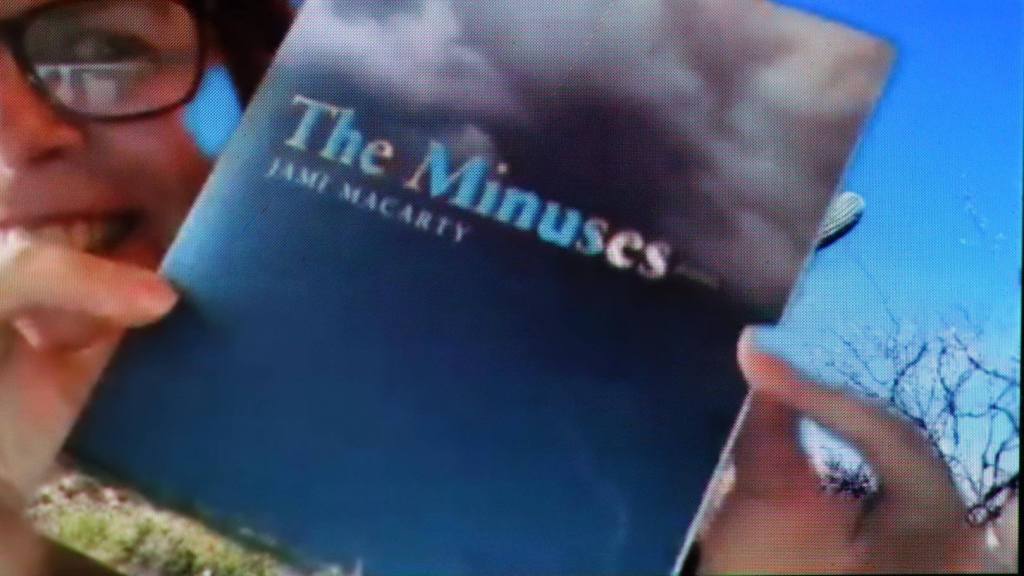
+ Thank you bows (continuous!) to my publisher Stephanie G’Schwind, and Mountain/West Poetry Series editors Donald Revell and Kazim Ali, et al interns at the Center for Literary Publishing (CLP) for making The Minuses (2020) with me.
+ Thank you bows (continuous!) to Beth Svinarich et al staff at University Press of Colorado for their beautiful support to me and The Minuses.
+ Thank you bows (continuous!) to monsoon storm chaser and marvelous professional photographer, Liz Kemp, whose monsoon photograph storms the cover of The Minuses.
+ Thank you bows to Nomados Literary Publishers, Meredith and Peter Quartermain for making my chapbook Instinctive Acts (2018)with me.
+ Thank you bows to Vallum Chapbook Series and editors Leigh Kotsilidis and Eleni Zisimatos for making my chapbook Mind of Spring (2017) with me.
+ Thank you bows to Finishing Line Press and editors Leah Maines and Christen Kinkaid for making my chapbook Landscape of The Wait (2017) with me.
+ Thank you bows (continuous!) to Vincent K. Wong for his friendship, creative collaboration, and for taking my author photos.
+ This bears repeating: Thank you bows (continuous!) to you, dear reader, for the gift of your attention! If you have any questions or comments, write me! I would love to hear from you!



 Jami Macarty