! Books !

Welcome to our meeting place where we talk about writing, making, reading, and reviewing books!

I am writing to you on Martin Luther King’s birthday. I write to you on this auspicious day to honor Dr. King and you, Dear Reader, as a member of my Beloved Community. Though Fellowship of Reconciliation founder Josiah Royce coined the term Beloved Community, Dr. King popularized it with the intention of advancing goodwill for all people sharing life on Earth.
I have been thinking a lot about the connections books facilitate and how reading engenders community, communing, and conversation. Conversations like the one I have with you here, and the conversations I have with other writers.

On December 11, 2024, Vallum Society for Education in Arts and Letters hosted a space for Canadian poet T. Liem to interview me on the making of my fourth chapbook The Whole Catastrophe (Vallum Chapbook Series, 2024).

In the interview’s introduction, T. Liem describes their reader’s enagement with the poems of The Whole Catastrophe:

Read my response to T’s opening remarks and the entire interview, titled An Inked Shorthand of Marks, in which we talk about exploding vilanelles, what poetry can do for us, verbing and nouning words, and personal and ecological grief. Join our conversation!

When poets offer poetry readings together, they make possible multiple facets of connection and conversation between themselves, among their books, and with the readers/listeners who attend. On December 7, 2024, POG Arts Tucson and Chax Press hosted me, Sarah Rosenthal, and Valerie Witte at Tucson’s 326 Gallery to read from our recent poetry collections.

The action shots (above) of us, our introducers, and some of the beautiful audience members who extended their ears and hearts to us, made for a lovely, rich, full evening of conversation about books.

Sarah, Valerie, and I have planned more gathering places for ourselves, our books, and others in Santa Fe later this month and early February. Join us if you can!

Reviewing is another facet of conversation that spirals out from books. A review faciliates conversations between author and reviewer and between reviewer and other readers of the book, and carries the possibility of building a community of readers around a book. In 2024, I offered 40 reviews, totalling almost 12,000 words, to poetry titles. Two long-form reviews were published in Colorado Review and The Malahat Review. Thirty-eight short-form reviews were published in NewPages. I tried to write four reviews a month… See the list below for when I achieved that goal.

2024 REVIEWSAn offering of 40 reviews!

Reviewing is much more than a numbers game to me. I think of my reviewing as a practice in attention for myself and as service to writers in my/our creative community. I focus my attention especially on the underrepresented voice of writers who identify as women, BIPOC, and LGBTQ, and the small presses within the publication world. I write reader’s response reviews to understand how a book has impacted me, to support the writers and publishers of books, and to support the magazines that publish reviews, which in turn support me by publishing the reviews I write. Together we form a big, beautiful community, congregating around books. Hurrah, books!

Before there can be any of the outward spiralling from books described above, there is the inward spiralling as reading impacts my reader’s imagination. Books teach me how to read. They teach me the thrill of discoveryof knowledge, interest, art. They offer company, and through representation, inspire me to be the person, woman, and artist I want to be in the world we share.

If you have been following these ! Books ! posts, then you may recall #mypersonalBigRead project. Begun in 2018 to address the stacks of unread books towering around my desk (and, if I am honest, throughout my house), the project now centers around my education in poetry and connection with other writers and readers.

In 2024, I read 262 books! Here are the stats for the project’s seven years:
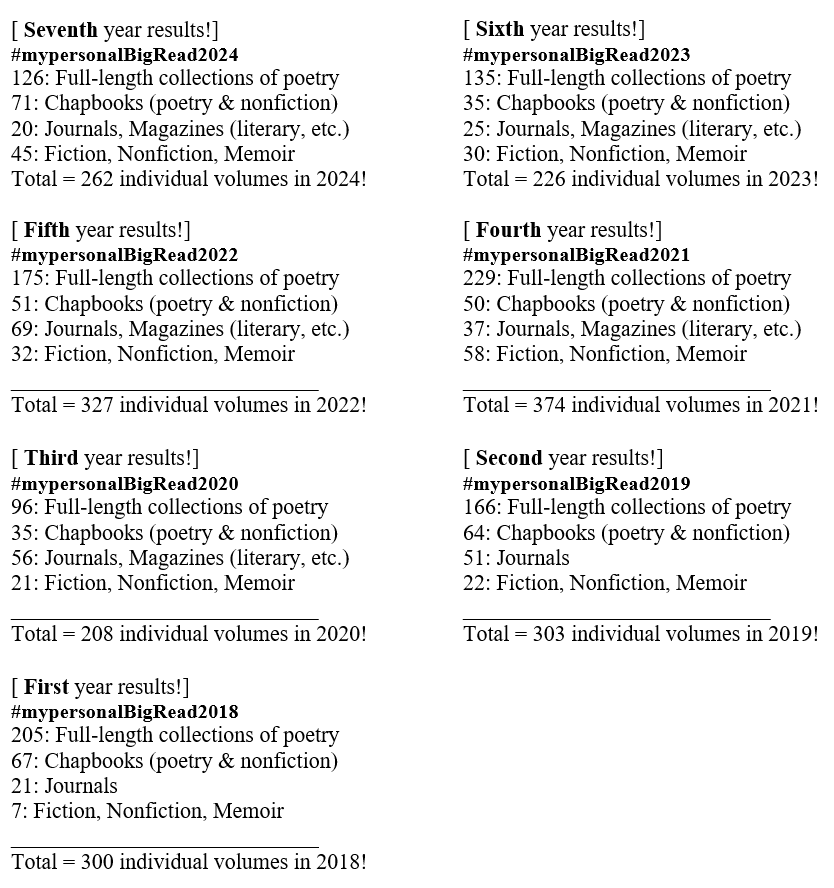
Ahem, that is a total of 2000 books, Dear Reader. I read 2000 books in seven years. I have to repeat it to believe it. Perhaps because I was a child of a single parent who neither read to me nor encouraged me to read, perhapas because I have a learning disability, perhaps because I am scared each time I pick up a book, wondering if I will be able to read it, reading 2000 books in seven years is a big deal! Hurrah books! ❤

: :

The Pluses!

+ Thank you bows (continuous!) to you, dear reader, for the gift of your attention! Welcome, welcome to those of you new to these dispatches on reading and writing books. May you find inspiration for your writer’s life!

+ Thank you bows to my community of women/women-identified writers for not coveting or competing, but sharing and supporting.

+ Thank you bows to Vallum Chapbook Series and Eleni Zisimatos, Editor, and Leigh Kotsilidis, Designer, for making my chapbook The Whole Catastrophe (2024) with me.

+ Thank you bows to T. Liem for their generous and generative conversation on the making of The Whole Catastrophe (Vallum Chapbook Series, 2024).

+ Thank you bows to POG Arts Tucson, Chax Press, Sarah Rosentha, and Valerie Witte for making and sharing space.

+ I bow to the editors who support my reviews and the publications where they were published: Denise Hill at NewPages; Stephanie G’Schwind at Colorado Review, and Jay Ruzesky at The Malahat Review.

+ I bow to Claudia Keelan and Andrew Nicholson, series editors, and the series board Sherwin Bitsui, Donald Revell, Sasha Steensen, and Ronaldo Wilson of Interim’s Test Site Poetry Series, who selected The Long Now Conditions Permit (forthcoming University of Nevada Press).

+ Thank you bows (continuous!) to my publisher Stephanie G’Schwind, and Mountain/West Poetry Series editors Donald Revell and Kazim Ali, et al interns at the Center for Literary Publishing (CLP) for making The Minuses (2020) with me.

+ Thank you bows (continuous!) to Beth Svinarich et al staff at University Press of Colorado for their beautiful support to me and The Minuses.

+ Thank you bows (continuous!) to monsoon storm chaser and marvelous professional photographer, Liz Kemp, whose monsoon photograph storms the cover of The Minuses.

+ Thank you bows to Nomados Literary Publishers, Meredith and Peter Quartermain for making my chapbook Instinctive Acts (2018)with me.

+ Thank you bows to Vallum Chapbook Series and editors Leigh Kotsilidis and Eleni Zisimatos for making my chapbook Mind of Spring (2017) with me.

+ Thank you bows to Finishing Line Press and editors Leah Maines and Christen Kinkaid for making my chapbook Landscape of The Wait (2017) with me.

+ Thank you bows (continuous!) to Vincent K. Wong for his friendship, creative collaboration, and for taking my author photos.

+ This bears repeating: Thank you bows (continuous!) to you, dear reader, for the gift of your attention! If you have any questions or comments, write me! I would love to hear from you!
! Books !

Dear Gentle Reader,

Hello, may you be healthy, and have had a marvelous summer. Happy Autumn!

Welcome back to my dispatches about making and reading books!

When I wrote to you in June, I was preparing to proofread the galley for my fourth chapbook The Whole Catastrophe. Galley v.1 arrived via electronic file, I printed it, then served the document’s pages to myself at the dining table where I commenced reading from the blue and white layered over a purple straw placemats with my chosen implements: a No. 2 pencil, a pink highlighter, and a TUL pen in purple.

From June 19 to July 17, Series Editor Eleni Zisimatos, Designer Leigh Kotsidilis, and I formed an editorial team of three patient souls devoted to preparing an error-free, print-ready manuscript of The Whole Catastrophe. We read and corrected. We took a break and awaited the bibliographic record for the Library of Congress (CiP data) and International Standard Book Number (ISBN). We fiddled with the front and back coversr. We read again and corrected again until we caught all of the niggly typesetting bits and pieces that went wonky when my Word file was transferred to a chapbook file. On July 9, the CiP data and ISBN arrived. On July 12, we finalized Rosie Long Decter’s attentive words (below) for the back cover. On July 17, we made the last line break correction to v.5. Et, Fin!

Publication Announcement

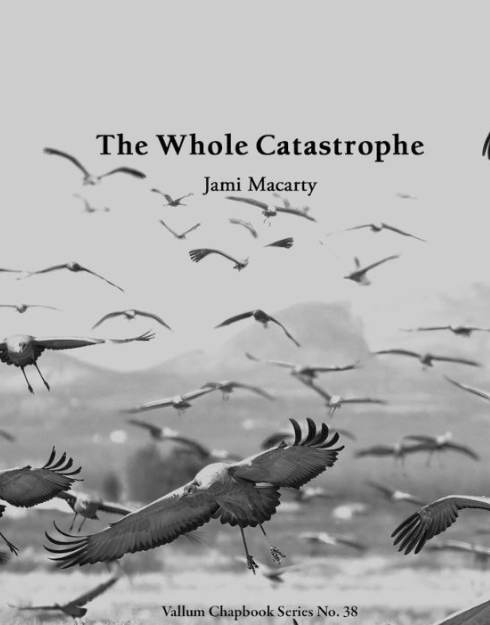
THE WHOLE CATASTROPHE
Vallum Chapbook Series No. 38
Jami Macarty

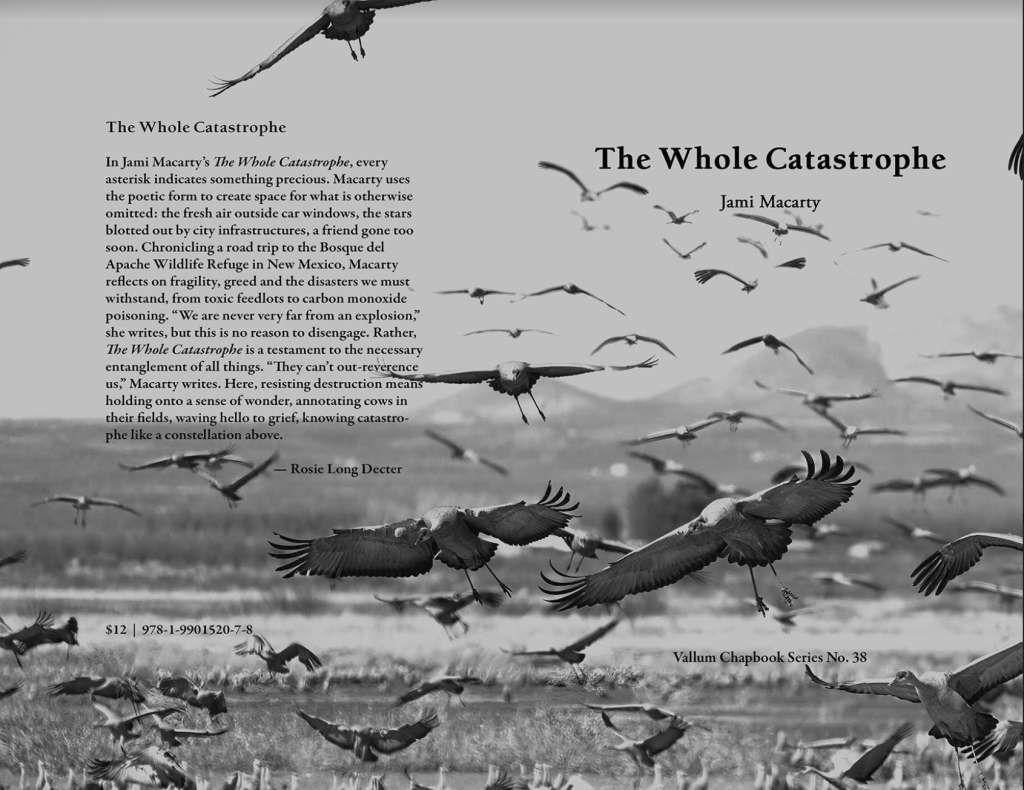
The Endorsement of Rosie Long Decter

In Jami Macarty’s The Whole Catastrophe, every asterisk indicates something precious. Macarty uses the poetic form to create space for what is otherwise omitted: the fresh air outside car windows, the stars blotted out by city infrastructures, a friend gone too soon. Chronicling a road trip to the Bosque del Apache Wildlife Refuge in New Mexico, Macarty reflects on fragility, greed and the disasters we must withstand, from toxic feedlots to carbon monoxide poisoning. “We are never very far from an explosion,” she writes, but this is no reason to disengage. Rather, The Whole Catastrophe is a testament to the necessary entanglement of all things. “They can’t out-reverence us,” Macarty writes. Here, resisting destruction means holding onto a sense of wonder, annotating cows in their fields, waving hello to grief, knowing catastrophe like a constellation above.

— Rosie Long Decter

Hurrah, Rosie and her endorsement! I especially love “a testament to the necessary entanglement of all things” for these words get at the soul of the poems in The Whole Catastrophe. Poetry Love!

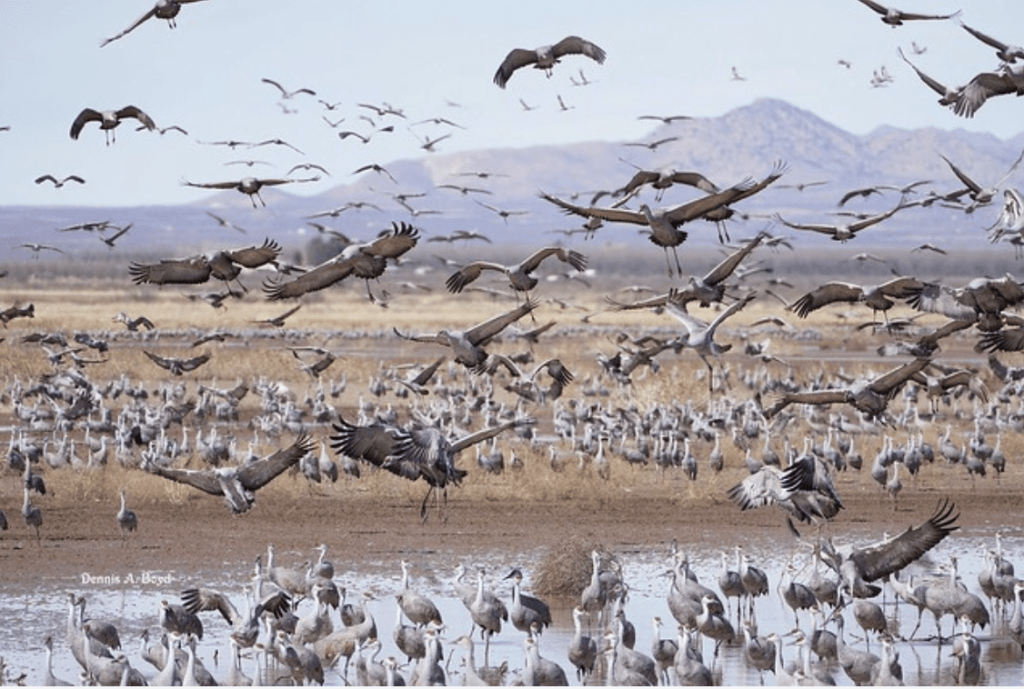
Sandhill Cranes Incoming, February 7, 2024

The first time I saw Dennis A. Boyd‘s full-color photograph of Sandhill Cranes at Arizona’s Whitewater Draw Wildlife Area (above) was on February 7, 2024 in a Facebook group of Arizona photographers. My heart took flight and my mind wilded. Every time I see Dennis’s gorgeous photograph, I am overcome. Something within in me mends. So, the moment I first saw Dennis’s photograph I knew it had to accompany the poems of The Whole Catastrophe which feature both Sandhill Cranes and Whitewater Draw. Hurrah, Dennis A. Boyd for agreeing to accompanying my art with his. Bird love!

I want to take you to Whitewater Draw Wildlife Area, one of my favorite places on Earth. From October to March, Whitewater Draw is a crucial roost site for migrating Sandhill Cranes (stock image, right). Some 20,000 thousand Sandhill Cranes overwinter at the Wildlife Area where they wade flooded fields and nibble corn stubble. They are typically joined by thousands of Snow and Ross’s Geese, among other migrating waterfowl. The cranes are an elegant sight to see and uproarious orchestra to hear! To get a sense of what it is to be in the presence of this many Sandhill Cranes, and to hear them, tune in to this two-minute video of Sandhill Cranes at Whitewater Draw recorded on January 26, 2024 by Arizona Game and Fish.

Now, let me tell me a bit about the poems in The Whole Catastrophe. The chapbook is comprised of three poems that mix documentary, elegiac, and ecological poetics attendant to the precariousness of our human and earthly lives. “Allowing for Betweens,” one of two long poems in the chapbook, records a roadtrip to Bosque del Apache National Wildlife Refuge in New Mexico and grieves the shocking death of a dear friend. A Mesostic poem, a type of acrostic poem invented by John Cage, celebrates the thousands of overwintering Snow Geese and Sandhill Cranes at Bosque del Apache. The chapbook closes with the title poem, a celebration of the ecstatic between lovers on a camping trip and a pledge of allegiance to wild lands.

I would love for you to read The Whole Catastrophe! I would love to know your reader’s response to the poems. Would you like to read The Whole Catastrophe? If so, you can purchase a copy from Vallum. Or, if you would like a signed copy, purchase one directly from me. I would be ever grateful to you for your best-of-all book-buying support. Contact me via a comment or email. xo

Forthcoming! Forthcoming!

  • Soon, on behalf of Vallum, T. Liem will be interviewing me about the composition of the three poems in The Whole Catastrophe.
  • Soon, Interim – A Journal of Poetry and Poetics (Since 1944!) will be publishing their “Finalist Issue,” featuring the semifinalists, finalists, and winners for the Test Site Poetry Series prize. That issue will feature some poems from my Test Site prize-winning manuscript The Long Now Conditions Permit (forthcoming University of Nevada Press). Included in the issue will also be one of the poems from The Whole Catastrophe (#38, Vallum Chapbook Series, 2024)…

: :

The Pluses!

+ Thank you bows (continuous!) to you, dear reader, for the gift of your attention! Welcome, welcome to those of you new to these dispatches on reading and writing books. May you find inspiration for your writer’s life!

+ Thank you bows to my community of women/women-identified writers for their generous, loving support, inspiration, and encouragement.

+ Thank you bows to Vallum Chapbook Series and Eleni Zisimatos, Editor, and Leigh Kotsilidis, Designer, for making my chapbook The Whole Catastrophe (2024) with me.

+ I bow to the editors who support my reviews and the publications where they were published: Denise Hill at NewPages; Stephanie G’Schwind at Colorado Review, and Jay Ruzesky at The Malahat Review.

+ I bow to Claudia Keelan and Andrew Nicholson, series editors, and the series board Sherwin Bitsui, Donald Revell, Sasha Steensen, and Ronaldo Wilson of Interim’s Test Site Poetry Series, who selected The Long Now Conditions Permit (forthcoming University of Nevada Press).

+ Thank you bows (continuous!) to my publisher Stephanie G’Schwind, and Mountain/West Poetry Series editors Donald Revell and Kazim Ali, et al interns at the Center for Literary Publishing (CLP) for making The Minuses (2020) with me.

+ Thank you bows (continuous!) to Beth Svinarich et al staff at University Press of Colorado for their beautiful support to me and The Minuses.

+ Thank you bows (continuous!) to monsoon storm chaser and marvelous professional photographer, Liz Kemp, whose monsoon photograph storms the cover of The Minuses.

+ Thank you bows to Nomados Literary Publishers, Meredith and Peter Quartermain for making my chapbook Instinctive Acts (2018)with me.

+ Thank you bows to Vallum Chapbook Series and editors Leigh Kotsilidis and Eleni Zisimatos for making my chapbook Mind of Spring (2017) with me.

+ Thank you bows to Finishing Line Press and editors Leah Maines and Christen Kinkaid for making my chapbook Landscape of The Wait (2017) with me.

+ Thank you bows (continuous!) to Vincent K. Wong for his friendship, creative collaboration, and for taking my author photos.

+ This bears repeating: Thank you bows (continuous!) to you, dear reader, for the gift of your attention! If you have any questions or comments, write me! I would love to hear from you!
++ The Minuses ++

Welcome, dear reader! You are most welcome here, where I share information about my and others’ books. Topics such as my reading and reviewing practice, my composition methods, writing and publishing process are taken up here.

The Minuses, my full-length collection, was published in February of this year, so recent posts have focused on what I’m referring to as “the pluses congregating” around The Minuses. Like a constellation of plus (+) signs, reviews, interviews, and readings offered in support of The Minuses shine their positive light and sprinkle sparkling stardust made up of the wondrous generosity of strangers, the special magic of collaboration, and the creative powers of community.

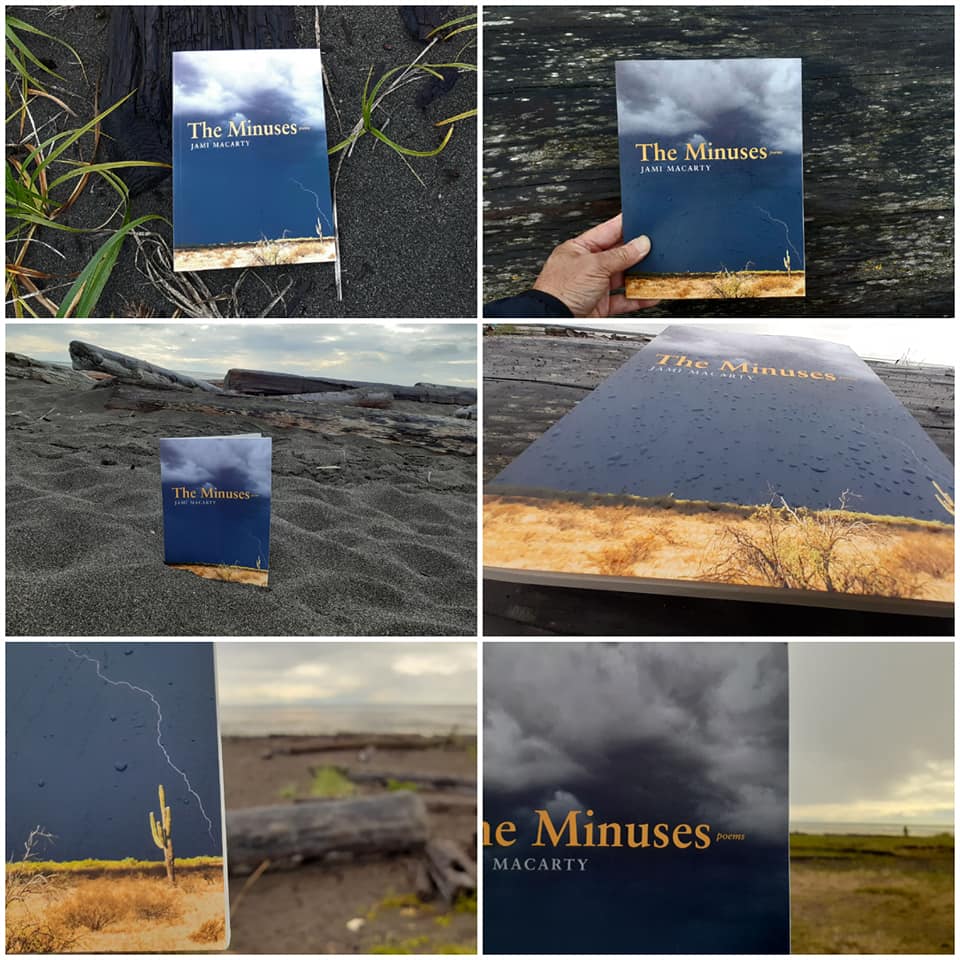
photos and montage created by Vincent K. Wong

Speaking of creative powers, the images and montage of my book above were created by my friend and photographer, Vincent Wong, who also took the author photo on the book’s back cover. Vincent and I met in an Simon Fraser University course I offered in 2012. From that day forward, Vincent has generously shared his creativity with me. He is a front and center collaborator with whom I have expansive art-talk and fun art walks.

Speaking of the generosity of strangers, Holly Mason offered to The Minuses an absolutely gorgeous, close reading-review at Entropy on September 14, 2020. This review sprung into being, in part, from my wondering about reviews, which put to a women’s writers group to which I belong this Q: Does a poet ask, wait, or hope for a review? I was wondering how proactive to be in inviting a review. From that simple gesture of willingness to ask a question, I received an abundance of supportive responses, offering perspective, information, and ideas for actions I could take. This women’s group is amazing! My query also brought to me the lovely Holly Morgan Mason, who said she’d like to offer a review to The Minuses.

Turns out, Holly and I had brushed poetry paths a few years ago. I didn’t remember, but Holly graciously reminded me that our poems had both been finalists in the Real Good Poem Prize, hosted by Rabbit Catastrophe Review. Kiki Petrosino, the prize’s judge, ended up selecting the title poem of The Minuses as prize winner, and in the process began the bringing together of Holly and me to be fulfilled these years later. I love this connection through the years with Holly; it enriches my sense of the potential of community. It’s been a special delight to reconnect with Holly, and an honor to receive the gift of her attention to my poems. Here’s an excerpt from her beautiful review:

The poems in this book are masterfully calibrated. The pacing is slow, careful, meditative throughout. There is space to breathe around the lines. Macarty’s phrasing delights and surprises. Like in the poem “Equals Rain” with the line “We pace the aisle of what happened to the sky.” Or in “Related Sequence” which ends with these stunning and echoing lines: “Loosening September sky// The day feels its own weight and buckles// In a window, a lace dress hangs itself” and ends without punctuation, asking us to consider the implications of the image.

an excerpt of Holly Mason’s review of The Minuses, published in Entropy

Read the entire

Entropy review

by Holly Morgan Mason

here!

: : : :

photos and montage created by Vincent K. Wong

The above montage reveals the sort of artist Vincent is; the sort who takes a desert book to the water! Largely set in the Sonoran Desert, The Minuses dearly appreciates being at the beach, near the water, and in the rain from above. Quenching!

Speaking of being in service of writing community, rob mclennan, invited me to participate in his project 12 or 20 (second series) Questions. My responses were published on September 17, 2020. rob and I have known each other via discussions on first books of poetry since 2008 ish. He’s a deeply engaged and community-minded poetry soul.

rob put to me all 20 of his series’ questions, which spanned topics such as first encounters with poetry, how poems begin, engaging in public readings, theoretical concerns behind my writing, and the role of the poet/poetry. Spending time with these questions, allowed me to contemplate and consider the map my creative life, including coordinates associated with best advice, moving between genres, collaboration, and influence. I’m entirely grateful to rob!

Here’s my response to 12 – When your writing gets stalled, where do you turn or return for (for lack of a better word) inspiration?

For me, it’s not so much that writing stalls. Writing continues, is continuous. Instead, it’s the ego that intervenes and enforces its will on the words. Or, it’s attitude (for me, especially, frustration at how long it’s taking) that gets in the way of the flow and stalls it. I’ve learned (mostly!) to recognize when persistence will be a case of diminishing returns. So, rather than put up my dukes, I take a break. More often than not I go for a walk. Solvitur ambulando! During these times, I don’t have a sense of needing to be inspired, but rather needing to clear a clog or shift attention. Sometimes there’s this sense that what’s unfolding in the writing needs some privacy. So, stepping away, looking away can give it some necessary space. The break has to take place at the energetic, kinesthetic level. Taking a shower, preparing food might also provide space. That’s day to day. Thinking longer term, to meet a sense of staleness, I make visual collages. Often the collages provide an image and color palette for a poem. To bring energy and myself back to words, I invent wild, impossible, contortionist writing constraints that are part goose chase and part scavenger hunt. To meet loneliness, I collaborate with another writer, sending weekly responsive transmissions back and forth. Since September 2019, I and poet, Sean Singer, have been writing a poem together; it’s 36 pages long so far. Or, I may elect to write in community a poem a day with some other poets.

-my response to rob mclennan’s question #12

Read the entire

12 or 20 (second series) Questions

interview

here!

: : : :

+ Thank you bows to lovely person and fine poet Holly Morgan Mason for her gorgeous, full-of-care review of The Minuses; bows also to Entropy and staff for making a place for Holly’s review of my poetry collection.

+ In delightful association, thank you bows to Rabbit Catastrophe Review, the host of the Real Good Poem Prize, and the 2016 prize judge Kiki Petrosino, who selected the title poem of The Minuses as prize winner, and in the process began the bringing together of Holly and me to be fulfilled these years later.

+ Thank you bows to most generous, community-minded rob mclennan for the invitation to participate in his 12 or 20 Questions Series; bows also to rob for his immense support of the poetry community.

+ Thank you bows (continuous!) to publisher Stephanie G’Schwind, and Mountain West Poetry Series editors Donald Revell and Kazim Ali, et al interns at the Center for Literary Publishing (CLP) for making The Minuses with me.

+ Thank you bows (continuous!) to monsoon storm chaser and marvelous professional photographer, Liz Kemp whose monsoon photograph storms the cover of The Minuses.

+ Thank you bows (continuous!) to Vincent K. Wong for his artistic friendship, creative collaboration, and for taking my author photos.

+ Thank you bows (continuous!) to you, dear reader, for the gift of your attention! If you have any questions or comments, write me!

++ THE MINUSES ++

Dear Reader, an interview is a chance to practice the high art of conversation. A conversation is a plus!

I bring to your attention the June 9, 2020 plus of an interview that the most lovely human and excellent poetry reader, Dayna Patterson conducted with me and The Minuses. Dayna and I met in our conversation on the Poetry Hour (4-5pm PDT) that she hosts for Western C.A.R.E.S. (Community, Activities, Resources, Education, Support) at Western Washington University.

Watch and listen to conversation here (use password: 8Q.A!M.?)

photos and compilation by Vincent K. Wong; background image by Jami Macarty

The Poetry Hour interview took place over Zoom, of course. The photos and compilation above are by Vincent K. Wong, my good pal and a terrific experimental photographer. Vincent attended the event, with 40 other souls, and took these photos of Dayna and me.

I didn’t realize the background image of Sonoran Desert and its saguaro cacti came through and interpentrated the live image of me, shifting foreground and background, the live and the still until Vincent sent me the series of photos he took during the event. I love the photos and the special effects are a perfect visual component to a quality of feeling I’m trying to get at in the poems of The Minuses.

photo by Vincent K. Wong; background image by Jami Macarty

Here are the questions Dayna Patterson asked me during the interview:

  1. We’re here to discuss your recent collection, The Minuses. When I think of the phrase, “the minuses,” I usually hear it in conjunction with “the pluses and the minuses.” With that title holding only the last part of the phrase, I expected that the book would press into themes of loss, negation, and deprivation. It certainly did that, and in ways that surprised me. For example, the book seems to be built from the scrap of a wrecked relationship. Is that an accurate description? Would you read the first piece for us and talk about why you selected this title for your book? 
  2. There’s a lot of verticality in this collection, a motif that in some places conjures, for me, a feeling of vertigo, and in other places a kind of longing to be detached, above the fray, so to speak. How were you working with notions of verticality vs. horizontality in this collection? (Read “Flight Hours,” “Mountain Hypotenuse,” and/or “Nor’easter”)
  3. How and when did you become so intimately acquainted with the landscape of the Sonoran Desert and its environs? What was your research process for the poems in this collection? (Read “Monsoon Desert,” “At Gravity’s Feet,” & “Music 5:30.”) I’m particularly interested in the phrase “I sent myself into the desert to become a third person” in “At Gravity’s Feet.”
  4. Can you talk about the way these poems lean into the colon and the double colon? For you, does the colon represent a kind of mathematical equation rendered into syntax? (Read “By Virtue of And”)
  5. A poem that really resonated for me from this collection is “Door Ratio.” Would you mind reading that one for us?
  6. Your notes section is expansive, specific, and generous. Why include the Latin name for each species you mention in the notes? How do you decide what to put in the notes to a collection?
  7. Is there anything else you’d like to share about the making of this book?
  8. What are you working on now or next?
  9. Who are some of the writers or artists that inspire you? In particular, are there contemporary poets you’d like to recommend to our audience today?

And, here I am endeavoring to arrive at answers, to be responsive.

photo by Vincent K. Wong; background image by Jami Macarty

Dayna’s and my conversation was followed by a Q&A with our audience of listeners and joining souls.

Watch and listen to conversation here (use password: 8Q.A!M.?)

: : : :

+ Thank you bows to Goddess Dayna Patterson for reading The Minuses, for her thoughtful questions, and for featuring and hosting me on the Poetry Hour for Western C.A.R.E.S. at Western Washington University.

+ Thank you bows to Western C.A.R.E.S. at Western Washington University and Goddess Athena Roth for offering her very fine administrative support during the event.

+ Thank you bows to the 40 souls with their beautiful ears and minds who joined me et al for the June 9 interview and conversation.

+ Thank you bows (continuous!) to publisher Stephanie G’Schwind, editor Donald Revell, et al interns at the Center for Literary Publishing (CLP) for making The Minuses with me.

+ Thank you bows to you, dear reader, for the gift of your attention!

The Minuses

Allow me to share with you some of the words that have congregated around The Minuses during the intervening months since my last post.

Some of those words took air in interviews; interviews, those blessed conversations—

February 13: With Susan Gillis on her blogspot, Concrete & River, Susan and I talk about the forces that bring us to poetry and the movement that combines ecological and feminist concerns—ecofeminism.

Of the ignitions to poetry, I talk about a begining bird, the color yellow, and the first formerly memorized poem of my life, which is from Robert Louis Stevenson’s A Child’s Garden of Verses. Here’s an excerpt of “Time to Rise”:

           A birdie with a yellow bill
           Hopped upon the window sill.
           Cocked his shiny eye and said :
          ‘Ain’t you ’shamed, you sleepy-head ?’

Birds Don’t Shame is the title of Susan’s and my conversation; visit Concrete & River to read more about why I don’t think so.

: : : :

February 20: With Jess Turner, Managing Editor of Colorado Review, at the Center for Literary Publishing blog, where Jess casts expansive inquiry, and I make my answers in the now of our conversation.

Perhaps because my logic is circular, Jess gave our conversation the title: “She acknowledges the circle. / There is no obvious beginning,” taking two lines from the poem,”The Calling” in The Minuses. Here’s the poem in its entirety:

The Calling

                        of something within

Rather than investigate meaning

                        or make a world of thought

                        she acknowledges the tendency

                        of a broken line to curve.

She acknowledges the circle.

There is no obvious beginning.

The circle navigated by coordinates

                        polar, parametric, Cartesian.

Each point a locus of all points

                        holds to itself.

She edges the circumference

                                    leans far out from the edge

                        to fulfill her attraction

                        to what withdraws.

The height a bird flies depends on the bird.

A conversation is circular; take in Jess’s and mine: “She acknowledges the circle. / There is no obvious beginning,”

: : : :

Thank you bows to Susan Gillis and Jess Turner for the gift of conversation!

Thank you bows to you, dear reader, for the gift of your attention!